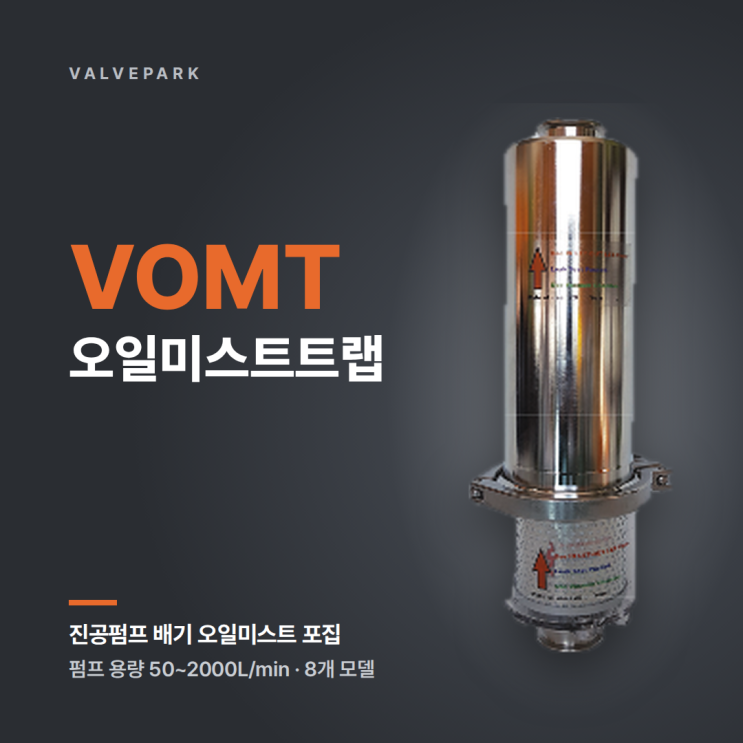
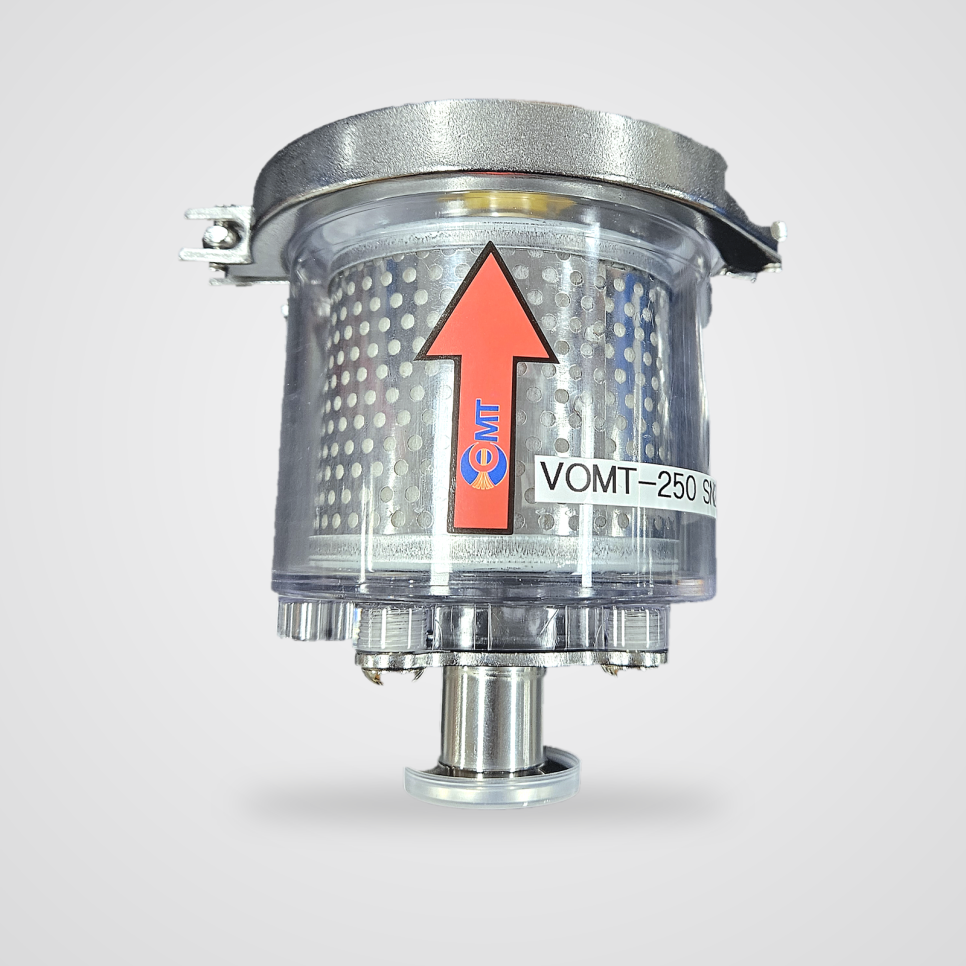
The actual VOMT-250. The transparent case lets you see the filter inside.
Use: capturing oil mist at the exhaust of oil-sealed vacuum pumps
Lineup: VOMT-250, 1000, 1500 and 2000 plus the chemical-resistant SUS304 S series, eight models in total
Selection criteria: vacuum pump capacity (L/min), exhaust NW size, case and gasket material, oil return, filter replacement
Option: safety vent that opens at 2bar or more (VOMT-1500, 2000, S1500, S2000)
Information for inquiries: pump model and capacity, exhaust size, oil type, exhaust gas, installation space
Hello, this is VALVEPARK.
In an oil-sealed rotary vane vacuum pump (a pump that seals its rotating parts with oil), pump oil leaves through the exhaust as vapor and fine droplets (oil mist) during operation, and the oil level drops. The part that catches this oil mist at the exhaust is the oil mist trap, and the Busan Vacuum VOMT series divides the pump capacity range of 50~2000L/min into eight models.
If you see oil stains or white smoke around the exhaust, or the oil top-up interval has become shorter, check the trap on the exhaust side first.
This article is based on the Busan Vacuum VOMT catalog, and VALVEPARK is an online dealer of Busan Vacuum.
In an oil-sealed pump, oil closes the gaps around the rotating parts and cools the pump, and because the operating temperature is high, oil vapor comes out of the exhaust together with the gas.
The more gas and vapor the pump draws in, the greater the oil loss, and the loss is even greater when gas ballast is used, which admits air so that condensable vapors do not condense inside the pump. Running without filtering the oil, in the worst case about 2cm³ of oil can be lost for every 1m³ of air at standard conditions that is pumped.
The oil mist separator fitted to the pump as standard does not remove all of the vapor, so some sites require the exhaust to be routed outside the building.
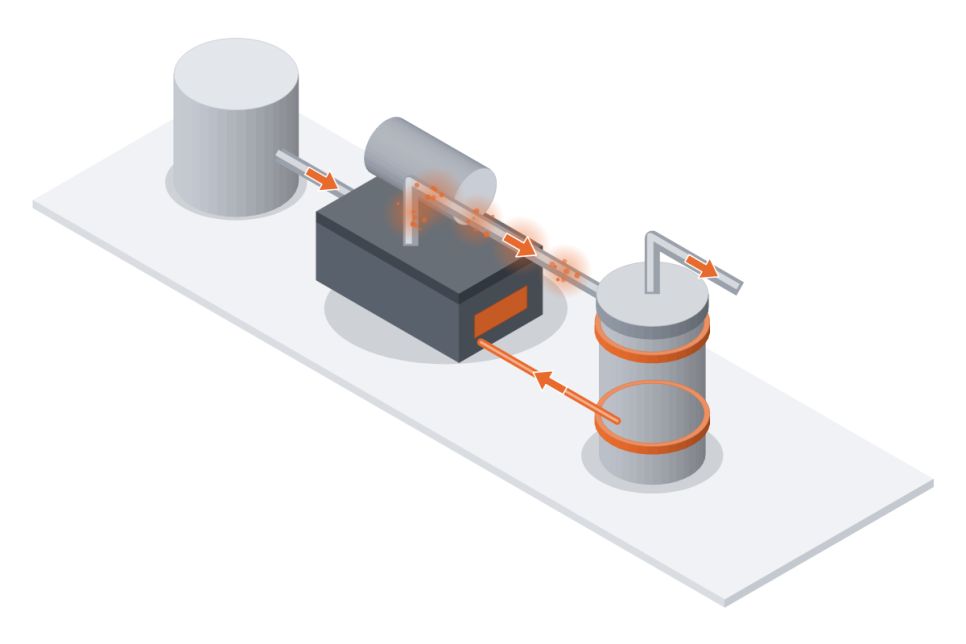
A concept diagram showing the layout of the chamber, oil-sealed vacuum pump and oil mist trap and how oil returns to the pump; the piping shape and amount of mist differ from reality
Oil caught at the exhaust and returned to the pump
The VOMT is a cylindrical trap connected to the pump exhaust with an NW (KF) flange, and oil droplets are caught as the exhaust passes through the filter material inside the case.
The filter is a cylindrical cartridge (VOMF) made of glass fiber, and as a One-Bolt Type fastened with a single bolt and a clamp, it is easy to replace. The filtered oil collects at the bottom of the case, and on the standard models an oil return port can be connected to send it back to the pump.
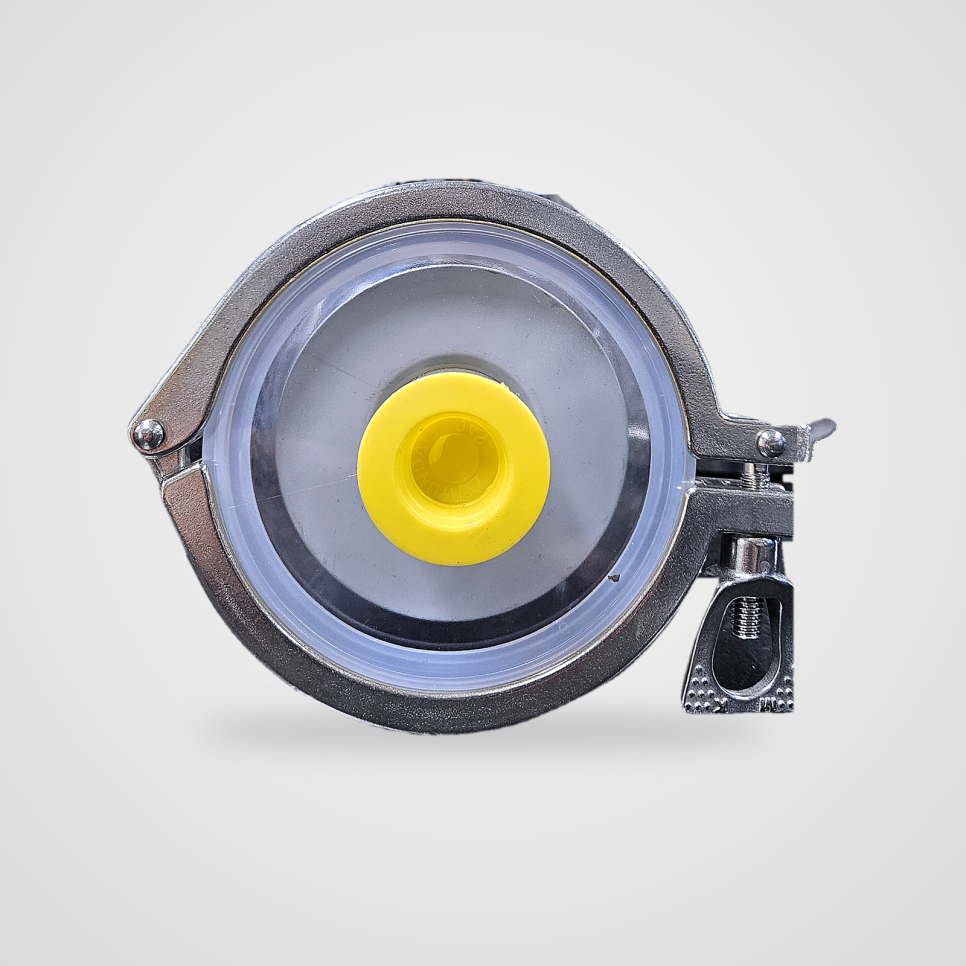
The cover and clamp of the VOMT-250
The VOMT-250 and VOMT-1000 have transparent cases so you can check the inside by eye, and the VOMT-1500 and VOMT-2000 let you see the oil level at the bottom.
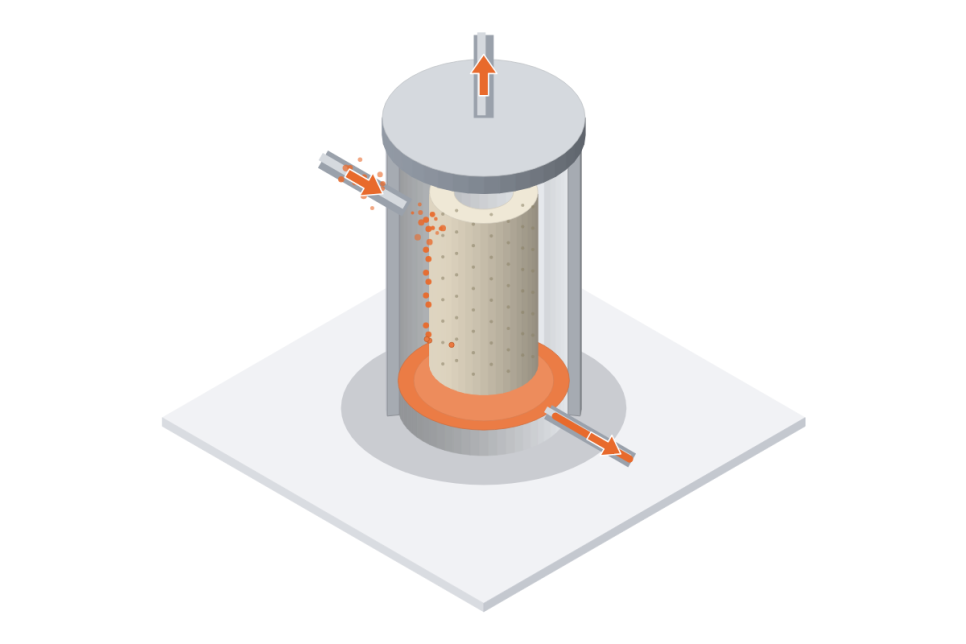
A concept diagram of how oil droplets in the exhaust are caught on the filter and oil collects below; the port positions and number of droplets differ from the actual product
Deciding in the order of pump capacity, exhaust size, material, filter and oil return, and maintenance narrows down the model.
1️⃣ Vacuum pump capacity: the catalog divides models by vacuum pump capacity (L/min), and where capacity ranges meet, the choice is made by looking at the pump model and operating conditions.
2️⃣ Exhaust size: check the NW designation of the pump exhaust; the sizes available differ by model.
3️⃣ Case and gasket: the standard models let you see the inside or the oil level and use silicone gaskets. The S series has a case made entirely of SUS304 and uses EPDM gaskets, and is dedicated to chemical resistance.
4️⃣ Filter and oil return: each model has a set VOMF filter configuration, and the standard models can connect an oil return port.
5️⃣ Maintenance: on the standard models, a heat-deformation film on top of the filter shows pump overload, and the S series has a 60℃ heat-deformation indicator attached on the outside.
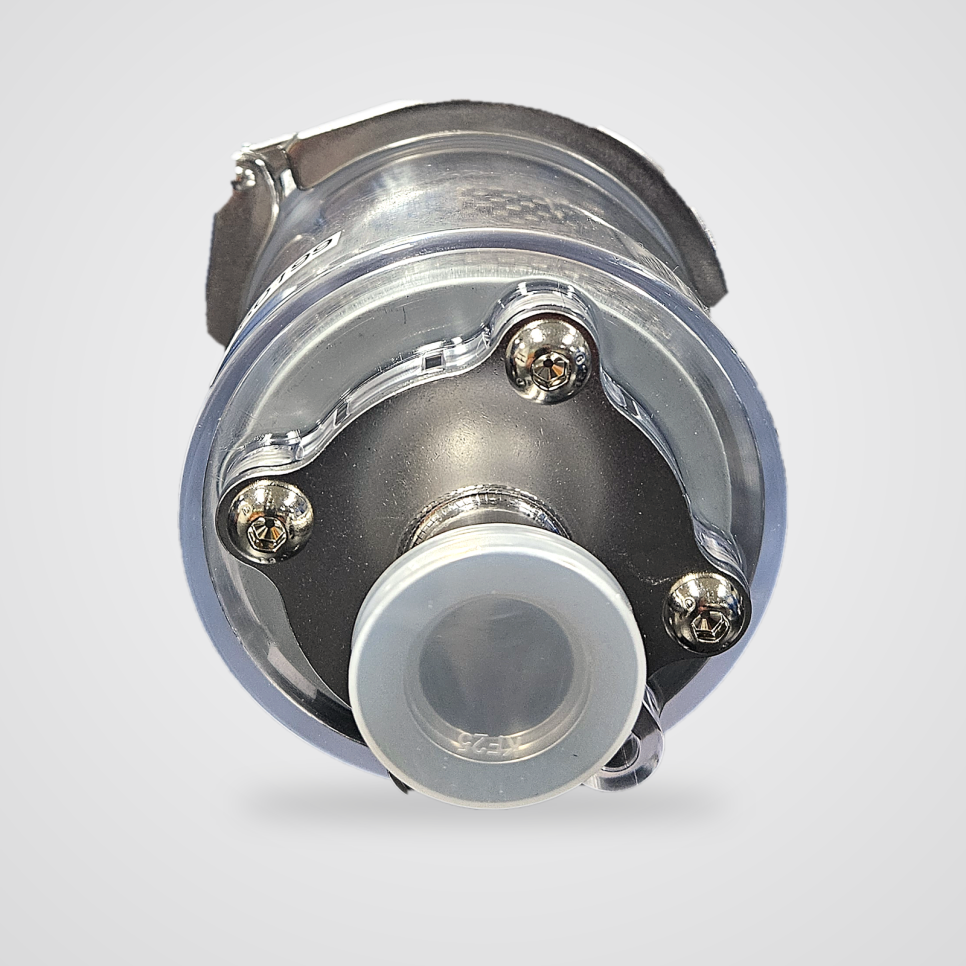
The bottom port of the VOMT-250. The sample in the photo is KF25 size
The filter configuration of each model is as follows.
VOMT-250: VOMF-500B
VOMT-1000: VOMF-1000B
VOMT-1500: VOMF-500B and VOMF-1000
VOMT-2000: VOMF-1000B and VOMF-1000
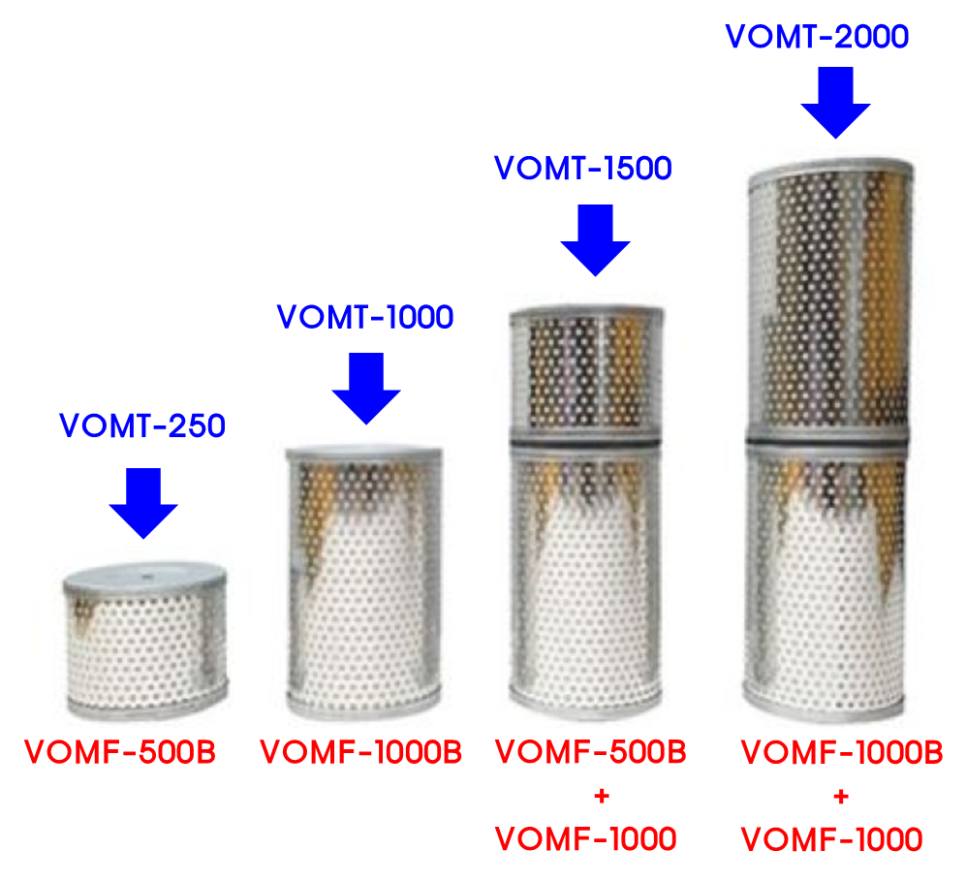
VOMF filters used in the VOMT-250, 1000, 1500 and 2000
Pressure at the pump exhaust rises by the amount it takes to pass through the exhaust filter, and as oil builds up on the filter, exhaust resistance can increase further. Check that the exhaust piping follows a route where condensate does not run back into the pump.
A separate IOMT trap exists for the inlet side (used in processes at a vacuum of 760~0.005Torr according to the catalog), while the VOMT is the model fitted at the exhaust. For pumps exhausting corrosive gases, choose the model after checking the gas type and concentration. The trap is a part that filters oil droplets, and the exhaust treatment of hazardous gases follows the site's safety standards.
By pump capacity range, the models are divided into standard models and the S series with SUS304 cases, and the specifications in the table are catalog values.
| Model | Vacuum pump capacity | Flange size | Filter, outer dimensions (incl. clamp) |
|---|---|---|---|
| VOMT-250 | 50~500L/min | NW-16, NW-25, NW-40; cover side NW-25 | ø90×75mm, ø130×145mm |
| VOMT-S250 | 50~500L/min | NW-25 | ø90×75mm, ø130×135mm |
| VOMT-1000 | 50~1000L/min | NW-25 or NW-40 (chosen at purchase) | ø90×150mm, ø130×248mm |
| VOMT-S1000 | 50~1000L/min | NW-25 or NW-40 (chosen at purchase) | ø90×150mm, ø130×225mm |
| VOMT-1500 | 1000~1500L/min | Cover NW-40, bottom NW-25 or NW-40 | ø90×225mm, ø130×325mm |
| VOMT-S1500 | 1000~1500L/min | Top and bottom NW-40 | ø90×225mm, ø130×315mm |
| VOMT-2000 | 1500~2000L/min | Cover NW-40, bottom NW-25 or NW-40 | ø90×300mm, ø130×398mm |
| VOMT-S2000 | 1500~2000L/min | Top and bottom NW-40 | ø90×300mm, ø130×385mm |
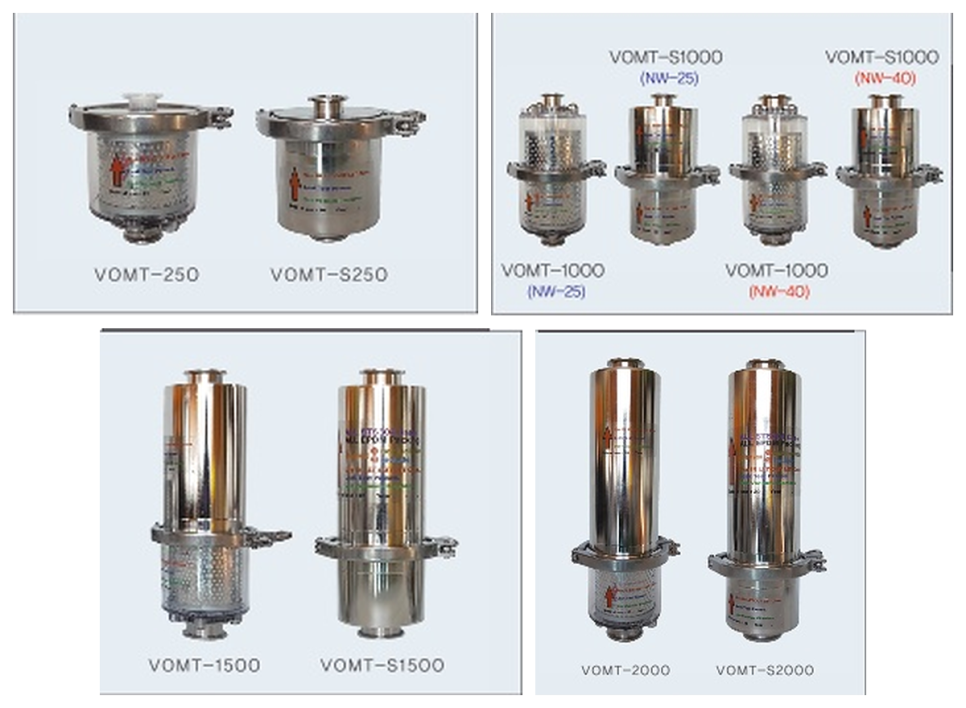
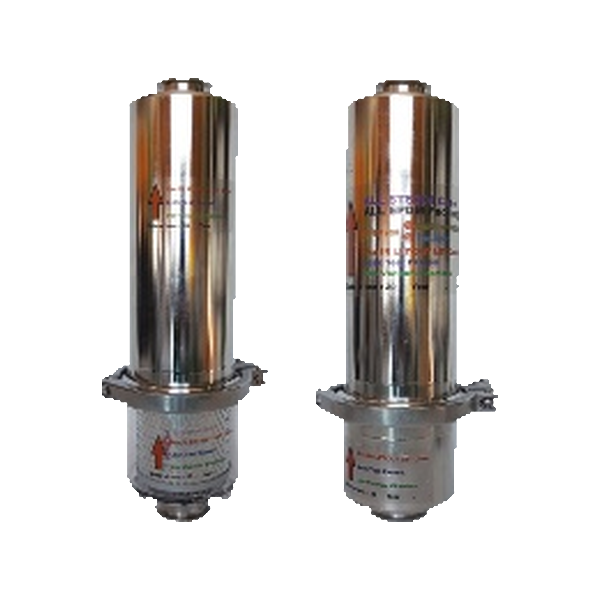
VOMT-250 and S250, 1000 and S1000, 1500 and S1500, 2000 and S2000 (catalog photo)
By capacity range, they are as follows.
50~500L/min: VOMT-250, VOMT-S250
50~1000L/min: VOMT-1000, VOMT-S1000
1000~1500L/min: VOMT-1500, VOMT-S1500
1500~2000L/min: VOMT-2000, VOMT-S2000
The configurations divided by pump capacity range and case material are as follows.
| 50~500L/min, view inside | VOMT-250 Transparent case, silicone gasket |
| 50~500L/min, chemical resistant | VOMT-S250 Entire case SUS304, EPDM gasket |
| 50~1000L/min, view inside | VOMT-1000 Transparent case, NW-25 or NW-40 selectable |
| 50~1000L/min, chemical resistant | VOMT-S1000 Entire case SUS304, EPDM gasket |
| 1000~1500L/min | VOMT-1500 Oil level visible at the bottom, safety vent option |
| 1500~2000L/min | VOMT-2000 Oil level visible at the bottom, safety vent option |
| 1000~2000L/min, chemical resistant | VOMT-S1500, VOMT-S2000 Entire case SUS304, top and bottom NW-40 |
Q. My pump exhaust is NW-25. Can I connect it to the larger models?
The VOMT-1500 and VOMT-2000 let you choose NW-25 for the bottom flange, so they can be connected to NW-25 piping. The cover side is fixed at NW-40, so also check the size of the piping that connects to the pump exhaust.
Q. Won't the pump exhaust pressure rise if the trap clogs?
It can, because exhaust resistance can increase as oil builds up on the filter. According to the catalog, the VOMT-1500, 2000, S1500 and S2000 can be fitted with an optional safety vent that opens automatically when a pressure of 2bar or more develops. Check the exhaust pressure your pump allows in the pump documentation, and since the filter replacement interval depends on the amount of oil and the gas load, set it by inspecting during operation.
Q. Can the S series be used on pumps that exhaust corrosive gases?
It can only be judged after checking the gas type and concentration. The S series is dedicated to chemical resistance with a SUS304 case and EPDM gaskets, but it does not suit every gas. Please let us know the process gas and the type of pump oil.
Q. Can the collected oil be sent straight back to the pump?
On the standard models, connecting the return port sends the collected oil back to the pump. However, with exhaust that contains water or solvents, the recovered oil can become contaminated, so inspect the condition of the pump oil to decide when to replace it.
If you send us the information below, we can start reviewing the right model.
1️⃣ Vacuum pump model and capacity (L/min)
2️⃣ Exhaust size (NW designation) and the size of the connecting piping
3️⃣ Type of pump oil and the gases mixed in the exhaust
4️⃣ Operating pressure range
5️⃣ Installation space (width and height), whether oil return will be connected, and quantity
If you need a specification sheet or detailed documents, please contact us.
▸ View product: Busan Vacuum VOMT oil mist trap for vacuum pumps
▸ See also: Vacuum KF hinged clamp (aluminum, double pin)
Purchase and Inquiries
| sales@valvepark.com | |
| Phone | 1666-0215 |
| KakaoTalk channel | KakaoTalk consultation |
| Website | Go to the VALVEPARK website |
| Smart Store | Go to the VALVEPARK Smart Store |