Hello, this is VALVEPARK.
Which End Connection should you choose for a butterfly valve? When you first encounter butterfly valves, terms such as Wafer, Lug and Flange can feel difficult from the outset.
These three, however, are not differences in the way the valve operates. They are easier to understand as differences in the connection method, the End Connection, which follows from how the valve is connected to and installed in the piping. Even for an identical butterfly valve, the appropriate End Connection changes according to the piping conditions and the purpose of the installation.
In this article we will review the three representative butterfly valve types, Wafer, Lug and Flanged, and finally look at the criteria to apply when selecting one on an actual site.
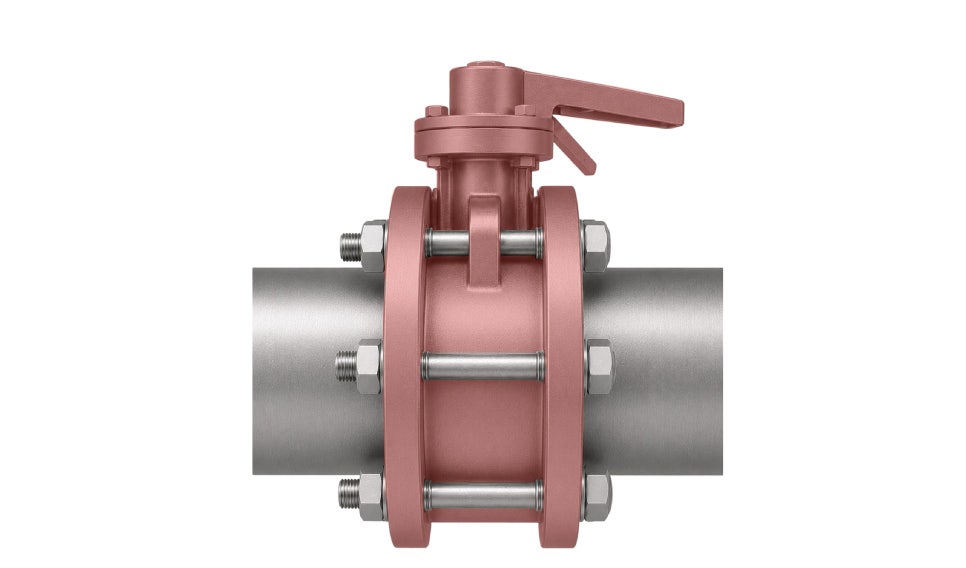
The Wafer type is a method in which the valve is inserted between two pipe flanges and secured with bolts. Rather than a structure in which a large flange is attached to the valve itself, it is easier to picture the flanges of the pipes on both sides holding the valve in place.
What are its characteristics? Its greatest advantage is that the structure is simple and it occupies little installation space. Because the valve is inserted between the pipe flanges and then fastened with through-bolts, installation can be relatively compact.
Accordingly, if economy and ease of installation are the priorities on a general piping line, the Wafer type can be reviewed first. In addition, the sealing structure inside the valve, such as the liner or an O-ring, can be designed to secure the sealing performance of the piping connection.
If you want a simple and economical installation on general piping → Wafer type
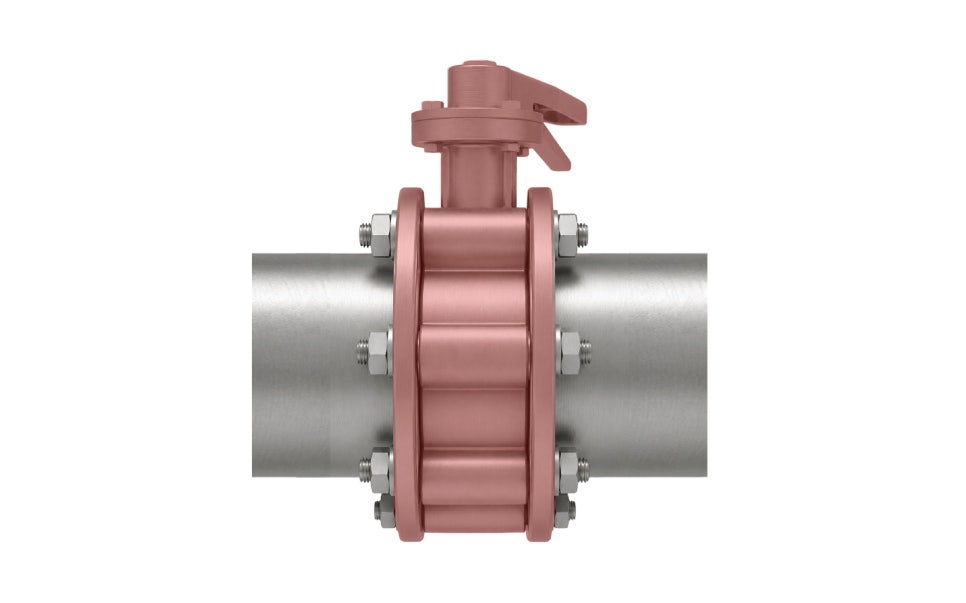
The Lug type looks similar to the Wafer type from the outside, but differs in that the valve body is provided with individual holes into which bolts can be fastened. These holes are called Tapped Holes, and the bolts are fastened directly into the valve body.
Put simply, if the Wafer type is a structure in which the pipe flanges hold the valve together, the Lug type is a structure in which the valve itself is connected to each pipe individually.
This difference is especially important in maintenance situations. For example, when one side of the piping has to be separated, the Lug type is advantageous because the valve can be fastened independently to each pipe side. It can also be used under conditions such as Dead-End Service. Dead-End Service here means a situation in which the piping behind the valve is no longer connected and the valve must hold pressure in that state.
Therefore, on a site where not only installation but also piping separation and maintenance have to be taken into account, we recommend considering the Lug type.
If the piping has to be separated one side at a time, or maintainability is important → Lug type
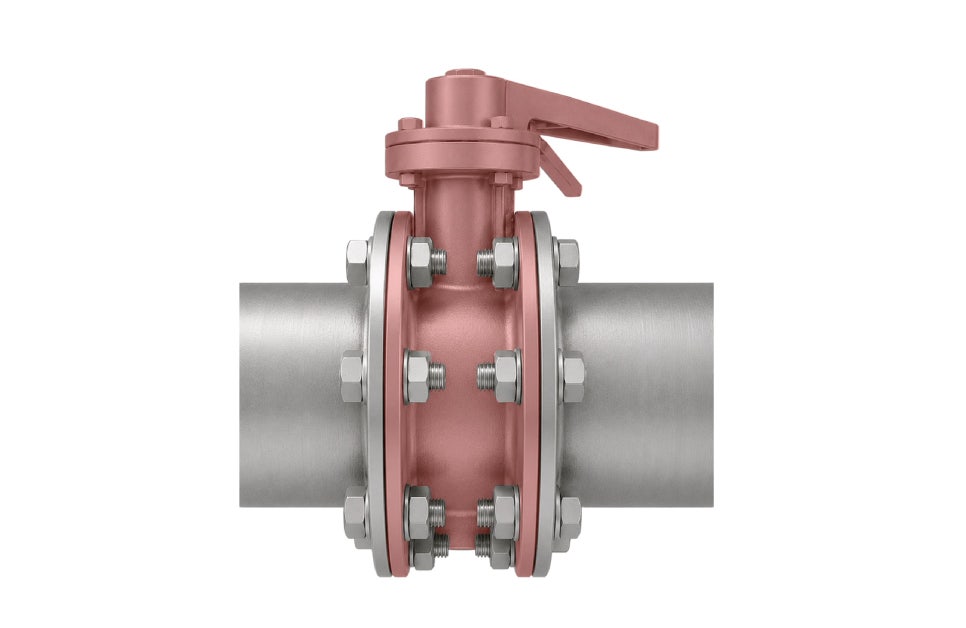
As the name indicates, the Flanged type is a method in which flanges are integrally formed on both sides of the valve. Because there is a flange at the pipe end and a flange on the valve as well, the two flanges are butted against each other and connected directly with bolts.
It is advantageous where the pipe flange standard or pressure rating specified for a project has to be matched exactly. For the Flanged type, Long Pattern and Short Pattern can be selected according to the installation length, so it can be applied to suit the space available in the facility and the piping design conditions.
If an exact connection to the pipe flange standard and a rigid fastening are important → Flanged type
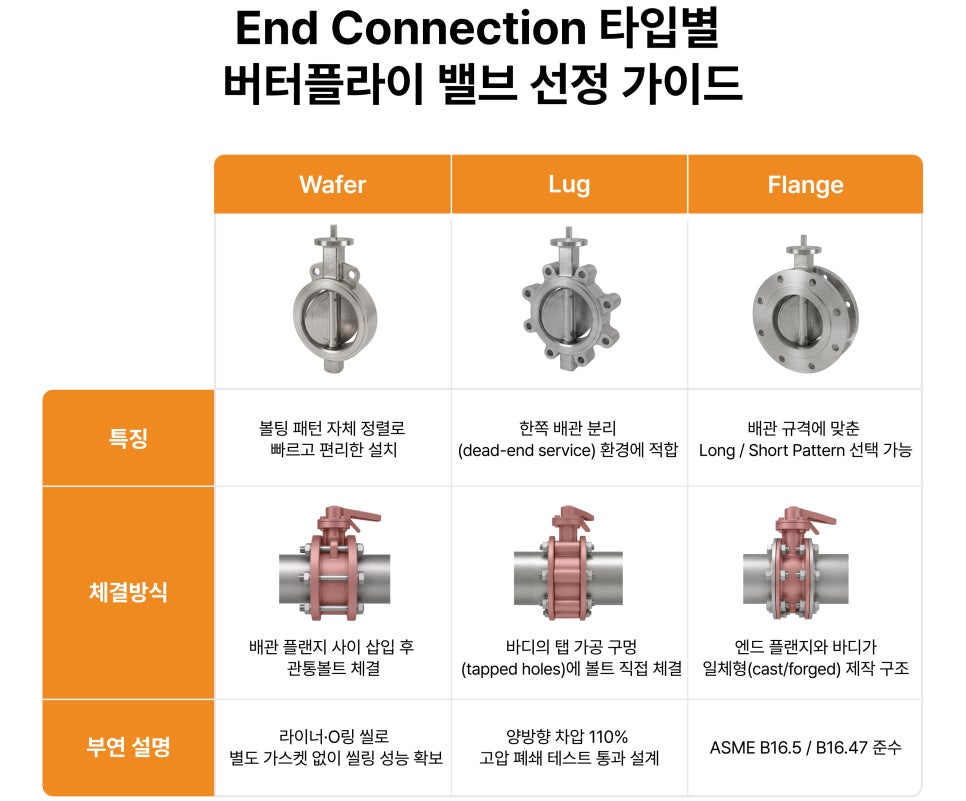
The important point here is that no particular type is unconditionally better. An End Connection is less a factor that decides the superiority of a valve than a specification chosen to match the piping environment in which the valve will be used.
STEP 1. Check how the piping is connected
The first thing to check is how the existing piping is connected. If flanges are installed on the piping, the standard and the dimensions of those flanges have to be confirmed. For example, even when the pipe size is the same, a different flange standard or pressure rating can mean the connection does not actually match. A valve must therefore not be selected on pipe size alone.
STEP 2. Check the purpose of installing the valve
Next, check what role the valve is to play. Consider whether it is simply for opening and closing the line, or whether the piping has to be separated frequently for maintenance of the facility. For a general piping line the Wafer type can be reviewed, but where the piping has to be separated independently the Lug type may be more suitable. Conversely, if the project calls for a specific flange standard or connection specification, the Flanged type should be reviewed.
Deciding the End Connection does not complete the valve selection. On actual industrial sites, pressure and temperature conditions are extremely important. For example, even for butterfly valves of the same size, the specification can differ according to the following conditions.
In particular, where a Lug type is applied, the pressure conditions required for Dead-End Service and the allowable pressure of the valve must always be confirmed in the manufacturer's specification sheet.
Finally, check which fluid passes through the inside of the valve. For a butterfly valve, not only the disc and the body but also the Seat/Liner material inside is an important selection factor, because the suitable material differs depending on whether the fluid is a general one such as water, a chemical, or a corrosive medium.
In actual product selection, therefore, the End Connection is not the only thing to be decided. The following have to be reviewed together:
End Connection + Size + Pressure Rating + Temperature + fluid conditions + Seat/Liner material
| Category | Wafer | Lug | Flanged |
|---|---|---|---|
| Connection method | Inserted between the pipe flanges | Bolts fastened into the tapped holes of the valve | Valve flange fastened directly to the pipe flange |
| Structure | Simplest | Similar to Wafer, but independent fastening is possible | Relatively rigid structure |
| Installation space | Small | Small | Relatively more required |
| Main advantages | Economy and ease of installation | Advantageous for maintenance and piping separation | Standard compliance and rigid connection |
| Main applications to review | General piping | Dead-End service, piping separation | Where flange standards and project specifications are important |
The End Connection of a butterfly valve is not a mere difference in external appearance. It is an important selection factor that determines the installation method, the maintenance approach, whether the piping can be separated, and the environment in which the valve is applied.
We hope this article helps you select a butterfly valve suited to your piping conditions. We will continue to share technical information that is useful in practice.
Email: sales@valvepark.com | Tel: 1666-0215
VALVEPARK is a trusted specialist in industrial valve supply, offering customer-specific specifications, fast delivery, and strict quality control.