Hello, this is VALVEPARK.
A butterfly valve is used to open and close the flow of fluid inside a pipeline.
They may look similar on the outside, but the structure and position of the disc greatly affect performance and the environments they suit.
Today, we'll take a simple look at the differences between the three most commonly used
types of butterfly valves: Concentric, Double Offset, and Triple Offset.
Let's first look at the concept of offset (eccentricity).
Simply put, it refers to how far the disc and shaft (stem) are offset from the center.
Without any offset, the disc keeps rotating while remaining in contact with the seat,
and the greater the offset, the faster the disc separates from the seat, reducing friction.
In short, more offset means less friction and higher durability and performance.
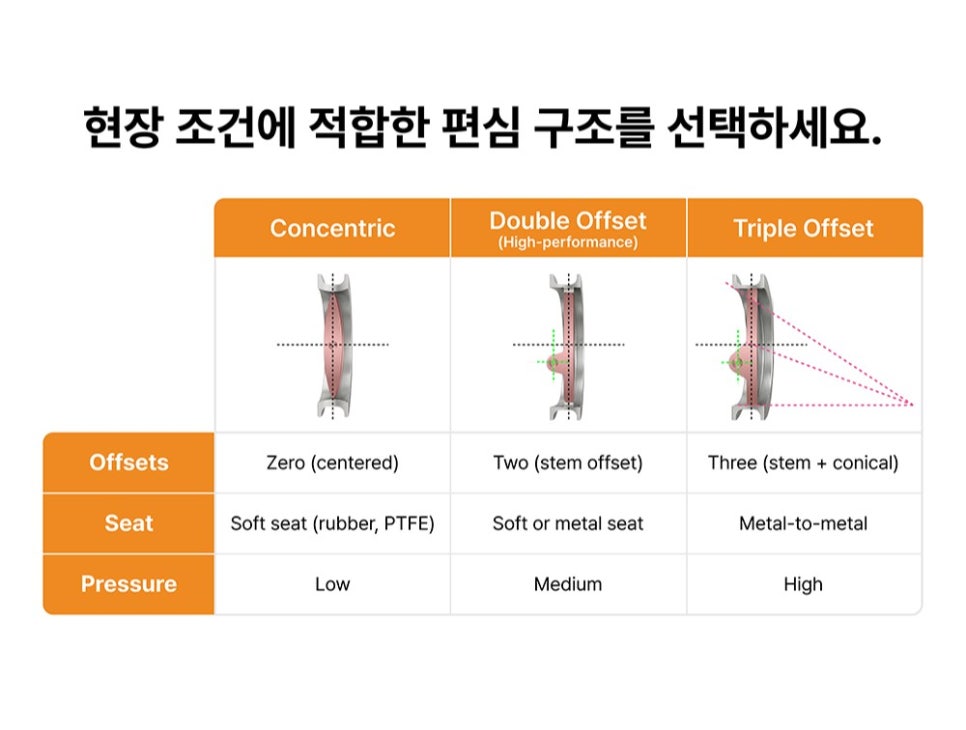
The Concentric type is the most basic design, with the disc and shaft positioned at the center of the pipe.
Because all centers align, the disc stays in continuous contact with the seat while rotating.
Features
✓ Simple structure.
✓ Lowest cost among the three types.
✓ Mainly uses rubber (EPDM, NBR) or PTFE seats.
| Advantages | Disadvantages |
|---|---|
| Easy to maintain. | Friction occurs continuously during opening and closing. |
| Capable of bubble-tight shutoff. | Seat wear occurs relatively quickly. |
| Excellent cost-effectiveness. | Not suitable for high-temperature, high-pressure environments. |
➜ Mainly used in water supply lines, cooling water piping, HVAC systems, and general industrial piping.
As the name suggests, the Double Offset butterfly valve applies two offsets in its design.
Because the disc separates from the seat as soon as it starts rotating, friction is greatly reduced compared to the Concentric type.
For this reason, it is also widely known as a High Performance Butterfly Valve.
Features
✓ Low friction.
✓ Can use either soft seats or metal seats.
✓ Suitable for medium-pressure piping and above.
| Advantages | Common Applications |
|---|---|
| Long seat life. | Chemical plants |
| Low operating torque for smooth actuation. | Oil and gas facilities |
| Excellent durability under repeated opening and closing. | Industrial process piping |
The Triple Offset valve adds a conical seat design to the Double Offset structure.
Its key feature is that the disc does not contact the seat until the valve is nearly closed.
Opening and closing take place with virtually no friction.
As a result, it delivers excellent performance even under high temperature and high pressure.
Features
✓ Uses a metal-to-metal seat.
✓ Suitable for high-temperature, high-pressure environments.
✓ Exceptional durability.
Advantages
Virtually no seat wear.
Long service life.
Can also be used in steam piping.
Provides high sealing performance.
➜ Mainly used in power plants, steam lines, refining and petrochemical plants, and high-temperature, high-pressure process environments.
| Category | Concentric | Double Offset | Triple Offset |
|---|---|---|---|
| Offset Structure | None | Double offset | Triple offset |
| Seat | Rubber, PTFE | Soft or Metal | Metal-to-Metal |
| Friction | High | Low | Minimal |
| Operating Pressure | Low | Medium | High |
| Operating Temperature | Low to medium | Medium | High |
| Durability | Moderate | Good | Excellent |
➜ Concentric
When you want to reduce costs
When used in low-pressure piping such as water supply or cooling water
➜ Double Offset
When opening/closing is frequent or durability is critical
When used in industrial processes such as chemical, oil, and gas
➜ Triple Offset
When used in high-temperature, high-pressure, or steam environments
When equipment requires high sealing performance and long service life
Butterfly valves may all look alike,
but their offset structure greatly affects performance and application.
Choosing the right type based on pipeline pressure, temperature, fluid characteristics, and operating frequency
can greatly improve equipment lifespan and reduce maintenance costs.
We will continue to share a variety of information about valves and piping components,
along with practical technical solutions, in an easy-to-understand way.
VALVEPARK - Everything About Industrial Valves
Industrial valve solutions made easy and fast! Experience all industrial valves and expert technical solutions in one stop, without a site visit!
www.valvepark.com