Hello from VALVEPARK.
When you first encounter piping or industrial equipment, one of the most confusing components is the flange.
Questions such as “What does RF mean?” and “Why don't JIS and ANSI fit together?” naturally come up.
To make it easy for beginners,
in this article we will walk through the flange face types and the differences between JIS and ANSI pressure ratings.

In simple terms, a flange face is
the shape of the contact surface where two flanges meet.
The sealing method, allowable pressure, and gasket type all depend on the structure of this contact surface.
The three most commonly used types are listed below.
• FF (Full Face)
• RF (Raised Face)
• RTJ (Ring Type Joint)
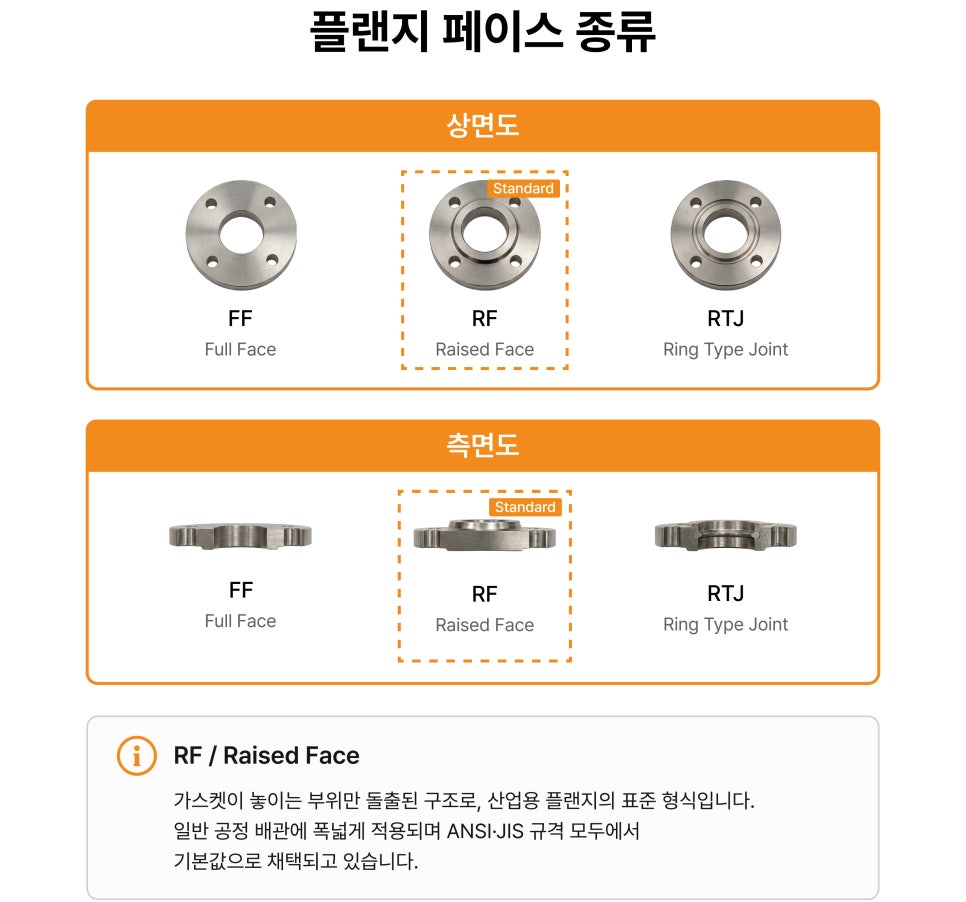
FF stands for “Full Face,”
meaning the entire face of the flange is flat.
The gasket also covers the full flange surface to match this design.
Features
✓ Simple structure
✓ Easy to assemble
✓ Common in low-pressure piping
✓ Frequently applied to PVC, cast iron, and similar piping
Advantages
It is the easiest form to understand from a beginner's standpoint.
Because two flat surfaces meet, the assembly is straightforward.
Disadvantages
Sealing performance can be limited in high-pressure environments.
RF stands for “Raised Face,”
and only the area where the gasket sits is slightly raised.
You can see in the image that the central contact area protrudes from the surface.
Why Is It So Widely Used?
Because the gasket pressure is concentrated in the center, sealing performance improves dramatically.
For this reason, industrial sites effectively treat RF as the default standard.
Why RF Is the Standard Format
1) Most Widely Used in Industrial Sites
Most general process piping uses the RF style.
2) Excellent Sealing Performance
Because gasket pressure is concentrated, leak prevention is highly effective.
3) Adopted as the Default Form in ANSI and JIS Standards
When there are no special requirements, RF is typically selected as the default.
In plain terms: when no specific flange type is called out, RF is the most likely choice.
RTJ is a specialty flange designed for high-pressure service.
A groove is machined into the flange face, and a metal ring gasket is inserted into it.
Features
✓ Outstanding sealing performance
✓ Suited to high-temperature and high-pressure environments
✓ Applied to petrochemical plants, power plants, offshore platforms, and similar facilities
Disadvantages
It is more expensive, requires precise machining, and demands careful assembly management.
It is more common in specialty industrial equipment than in general factory piping.
A flange must be evaluated not only by its shape,
but always by its pressure rating as well.
The two most widely used standards are listed below.
• JIS (Japanese Industrial Standards)
• ANSI (American National Standards Institute)
JIS and ANSI Are Not Interchangeable
This is one of the most common mistakes among beginners.
Even though they may look similar from the outside, the following details actually differ.
• Bolt hole position
• Bolt pitch (PCD)
• Outer diameter
• Pressure class
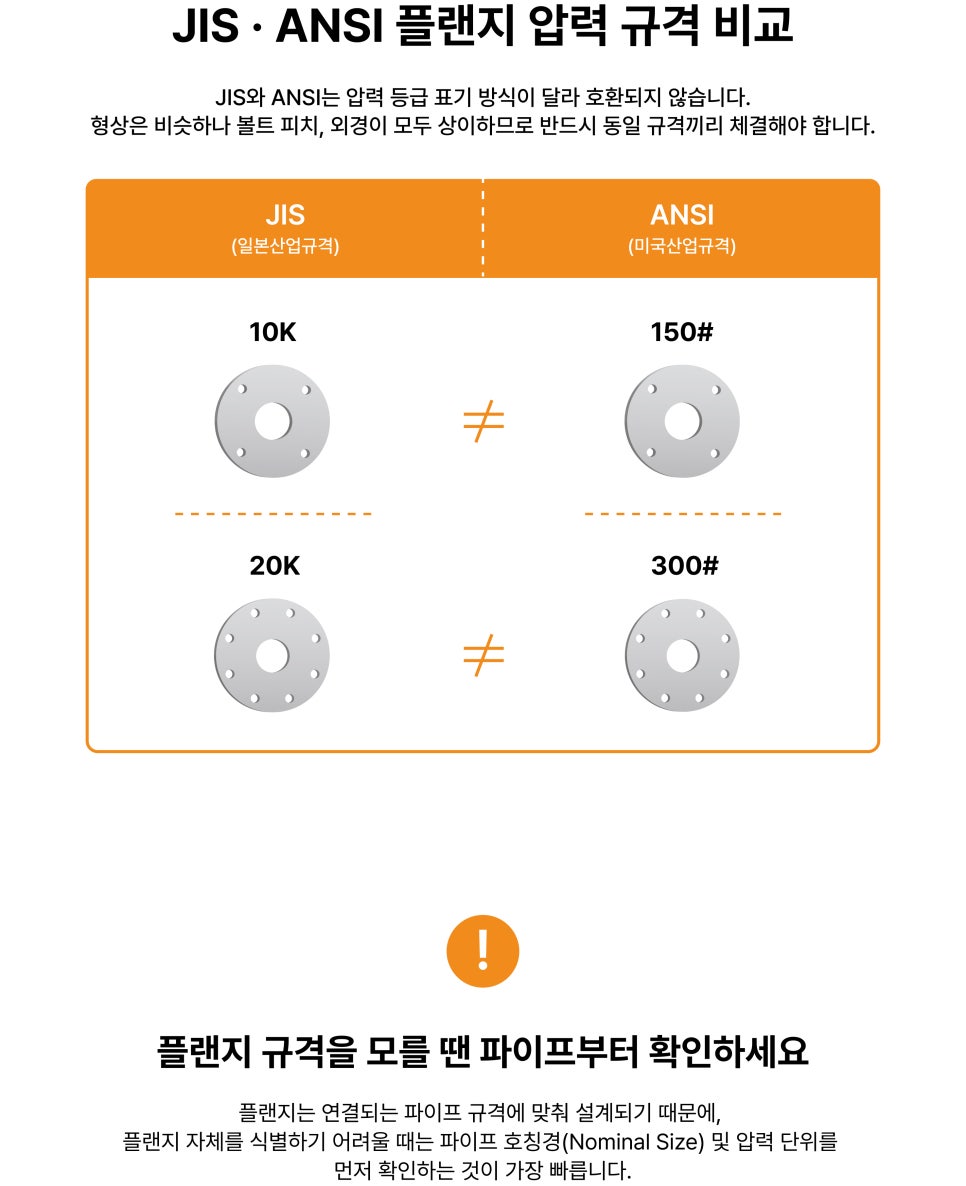
In other words,
JIS 10K ≠ ANSI 150#
JIS 20K ≠ ANSI 300#
Even though they look similar, the fasteners often do not match in practice.
For this reason, always connect flanges of the same standard.
What Do the Pressure Rating Numbers Mean?
JIS
➜10K ➜20K
uses the “K” unit format.
ANSI
➜ 150# ➜ 300#
uses the “pound class” concept.
Because the notation itself is different, compatibility must never be judged by raw numbers alone.
This is the fastest and most accurate method in the field.
Flanges are manufactured to match the specification of the pipe they connect to.
So when the flange specification is unclear, check the following first.
1. Pipe Nominal Size
e.g., 15A, 25A, 50A, 100A
2. Pressure Rating
e.g., 10K, 20K, 150#, 300#
3. Fluid and Pressure Conditions
Water / Steam / Oil / Gas, etc.
Once you have confirmed this information,
identifying the correct flange specification becomes much easier.
A flange may look like a simple connection component,
but in reality it plays a crucial role in controlling pressure and preventing leaks.
For beginners, remembering the three points below is enough.
FF = Flat, for low pressure
RF = The most widely used standard form
RTJ = High-pressure, specialty use
And the most important point is as follows.
JIS and ANSI may not be compatible with each other, so flanges of the same standard must always be paired.
We hope today's information on flanges and piping has been helpful in some small way.
We will continue to share easy, engaging information on piping and equipment that you can apply directly in the field.
We'll see you again in the next post with more useful content!
VALVEPARK - Everything About Industrial Valves
Industrial valve solutions, easy and fast! Experience every industrial valve and expert technical solution in one place, without an on-site visit.
www.valvepark.com