Product: HORA desuperheaters from Germany and steam conditioning valves
Use: Steam temperature control for power plant turbine bypass and process steam
Selection criteria: Load turndown, approach to saturation temperature, cooling water pressure, straight pipe length
Supply: VALVEPARK, the official HORA distributor, with service support across Asia
Hello, this is VALVEPARK.
A desuperheater lowers steam temperature to what the process needs by spraying water into a superheated steam pipe.
The right spray type depends on how widely the load varies, the target temperature, the cooling water pressure, and how much pipe length you can provide. VALVEPARK is the official distributor of Germany's HORA, supplying four types of HORA desuperheaters and steam conditioning valves.
Superheated steam is hotter than saturated steam at the same pressure, but its heat transfer coefficient (how well heat crosses the pipe wall) is low and not constant. As a result, using superheated steam as it is makes heat exchanger sizing difficult and temperature control unstable.
Cooling it close to the saturation temperature lets the steam transfer heat through the latent heat it releases as it condenses, so the same duty can be handled with a smaller heat exchanger. It also protects downstream equipment that is sensitive to high temperature, which is why desuperheaters are used in power plant turbine bypass and in steam lines of paper and chemical processes.
Close to saturation temperature, without leaving water behind
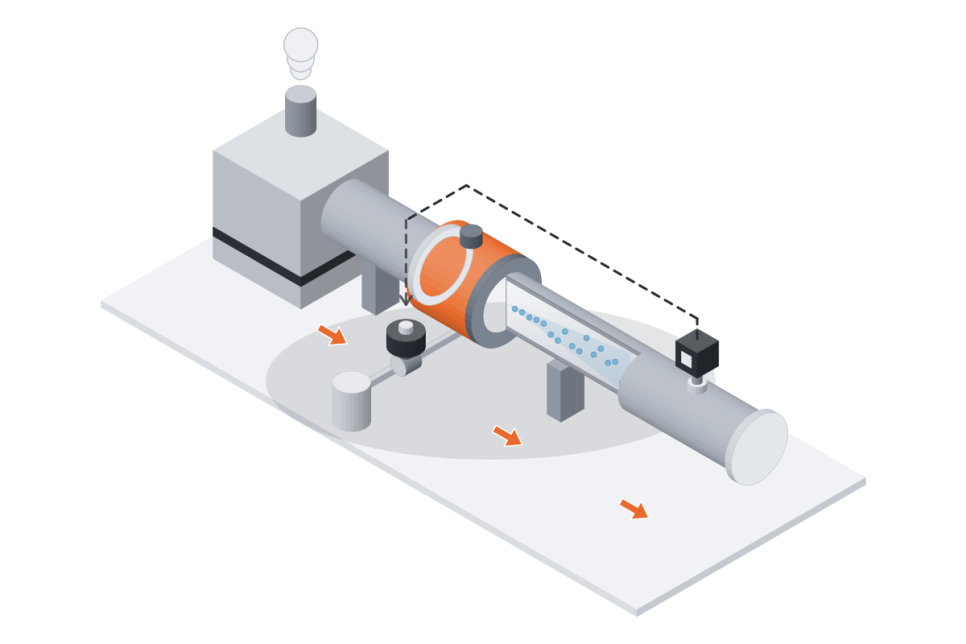
A configuration that sprays cooling water into a superheated steam pipe and adjusts the cooling water valve from the downstream temperature sensor reading
It does not hit the saturation temperature exactly. Depending on the type, the target is set a few °C above saturation.
If the target is set too close to saturation, the sprayed water cannot fully evaporate and may pool at the bottom of the pipe. If the temperature controller has a sensitivity of ±5 °C, it cannot tell saturation temperature from a state 5 °C above it.
For a process that can tolerate some remaining superheat, setting the target with some margin is better for operation. The temperatures each type can approach are the general ranges from technical literature below; actual values differ by manufacturer and conditions.
Single nozzle injection type: about 10 °C above saturation temperature
Multi-nozzle type: about 8 °C above saturation temperature
Steam-assisted type (breaks the water into fine droplets with auxiliary steam): about 6 °C above saturation temperature
Venturi type (mixes in water using steam accelerated in a narrowed pipe): about 3 °C above saturation temperature
Where water droplets must not carry over, such as just upstream of a turbine, place a moisture separator (a device that removes water droplets from steam) downstream. Even if control wavers and water comes through, the separator filters it out and protects downstream equipment.
If steam flow varies widely, the steam-assisted or multi-nozzle type fits. If it is nearly constant, the fixed nozzle or venturi type fits.
The first criterion for choosing a type is turndown (the ratio of maximum to minimum controllable flow). By the general ranges in technical literature, a single nozzle handles about 3:1 and a multi-nozzle type about 8 to 12:1.
The steam-assisted type breaks water into a mist with high-pressure auxiliary steam, keeping droplets suspended even at low velocity. It therefore runs stably at a turndown of about 20:1 and suits pressure-reducing and desuperheating lines with large flow changes.
The venturi type approaches saturation temperature closely, but its steam turndown is only about 4 to 5:1, so it suits lines with a constant load.
Types that put nozzles inside the pipe, such as the multi-nozzle type, do not suit small pipes. Technical literature generally puts the installation condition for nozzle-insertion types at pipes of DN 150 to 200 or larger.
Specifying turndown larger than necessary can leave the unit running only in the low part of its rating, which can make control worse. It is better to choose based on the current operating range than to include future expansion all at once.
The load variation range decides the spray type
HORA desuperheaters come in four types by how they spray water, with the limits below.
| HORA desuperheater | How water is sprayed | Max temperature | Max pressure rating |
|---|---|---|---|
| Multi-nozzle type | Spray rate adjusted by the number of nozzles a piston opens; integrated with the control valve | 600 °C | PN 400 / Class 2500 |
| Steam-assisted type | Water broken into fine droplets by high-pressure steam | 600 °C | PN 320 / Class 1500 |
| Injection lance type | Fixed nozzle with no moving parts | 530 °C | PN 160 / Class 600 |
| Venturi type | Steam accelerated in a narrowed pipe disperses the water | 550 °C | PN 250 / Class 1500 |
Multi-nozzle type: up to 600 °C, PN 400 / Class 2500
Steam-assisted type: up to 600 °C, PN 320 / Class 1500
Injection lance type: up to 530 °C, PN 160 / Class 600
Venturi type: up to 550 °C, PN 250 / Class 1500
The multi-nozzle type covers small cooling water quantities, with a Kvs (the valve flow coefficient) range of 0.04 to 10.7. The steam-assisted type handles large cooling water quantities up to Kvs 45, and the injection lance and venturi types are designed to the site conditions you provide.
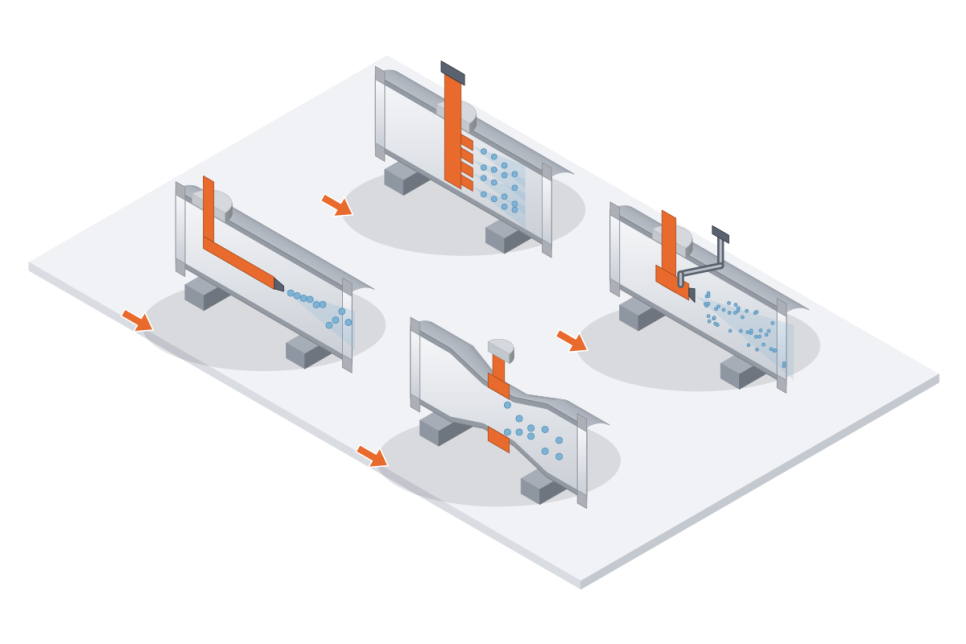
The multi-nozzle, steam-assisted, injection lance and venturi types spraying water inside a pipe
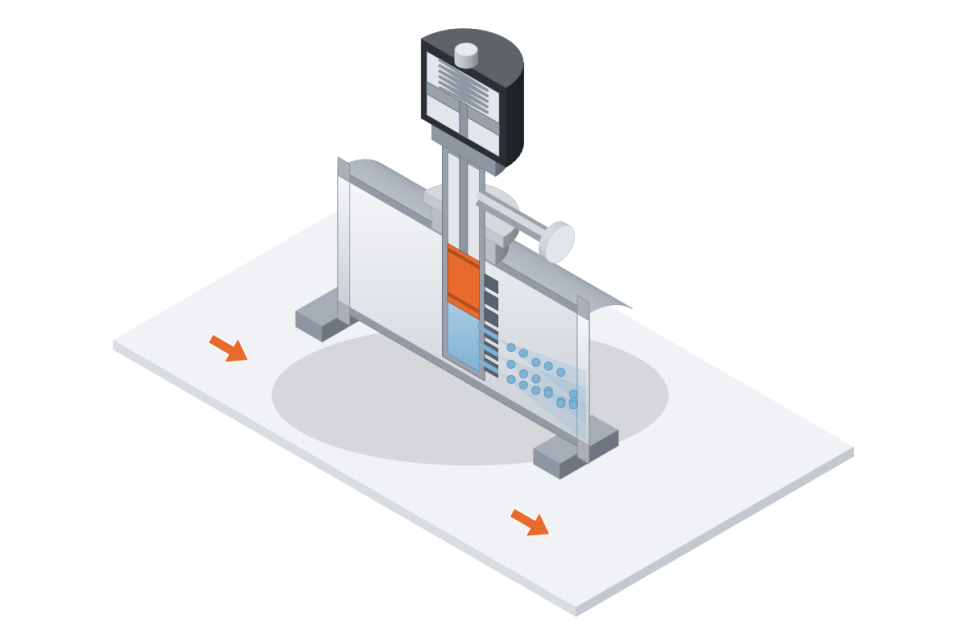
Cutaway of the multi-nozzle type, where more nozzles open as the piston rises and the spray rate increases
Nozzle injection types need cooling water pressure sufficiently higher than steam pressure. If that pressure is hard to secure, consider the steam-assisted or venturi type.
The larger the pressure difference across the nozzle, the finer the water breaks up and the shorter the straight pipe needed downstream.
The steam-assisted type breaks the water with auxiliary steam, so the cooling water only needs to be above steam pressure. In exchange, the auxiliary steam must be at least about 1.5 times the main pipe inlet pressure, so first check whether you can bring in such steam.
Use cooling water with low total dissolved solids (TDS) so deposits do not build up in the nozzle holes and downstream pipe.
Place a strainer ahead of the cooling water control valve and size the mesh to the nozzle size. The higher the cooling water temperature, the faster it evaporates and the less water falls onto the pipe wall; some configurations also use water from the boiler feed pump outlet.
After the injection point you need enough straight pipe and temperature sensor distance for the water to fully evaporate. This length varies by type and temperature difference.
If the sensor is too close to the injection point, it measures poorly mixed steam and sends a wrong value; if it is too far, only the installation section gets longer.
Manufacturers set this distance from the difference between the target outlet temperature and the saturation temperature, or the cooling water temperature. The desuperheater installation section described in technical literature is generally around 7.5 m.
An elbow or tee right after the injection point becomes a place where droplets hit before mixing, so arrange the layout to keep them out of that section.
If steam velocity is too low, droplets settle; if it is too high, there is not enough time to mix before they reach an obstacle. Technical literature sets the maximum pipe velocity in a range of about 46 to 76 m/s.
Mounting orientation is mostly free, but when installed vertically, steam should flow from bottom to top.
Slope the downstream pipe about 20 mm per meter in the flow direction and provide drains so water does not collect. Given steam velocity, pipe size and sensor distance, HORA determines the nozzle and injection position through flow analysis (CFD, computing the flow numerically).
Where pressure and temperature must both be reduced, a steam conditioning valve (pressure-reducing desuperheating valve) suits better than a desuperheater alone.
A steam conditioning valve puts a pressure-reducing control valve and a spray section in one body.
It mixes water in the disturbed flow right after pressure reduction, and the equipment to install and maintain is reduced to one unit. For these reasons this configuration is used in power plant turbine bypass (the system that routes steam around the turbine).
HORA steam conditioning valves handle conditions up to PN 630 / Class 4500 and 615 °C. Outlet piping is designed to sizes beyond DN 1000, and multi-stage cage trim (internal parts that reduce pressure in several steps) addresses noise and vibration.
Turbine bypass: pressure and temperature reduction in one body
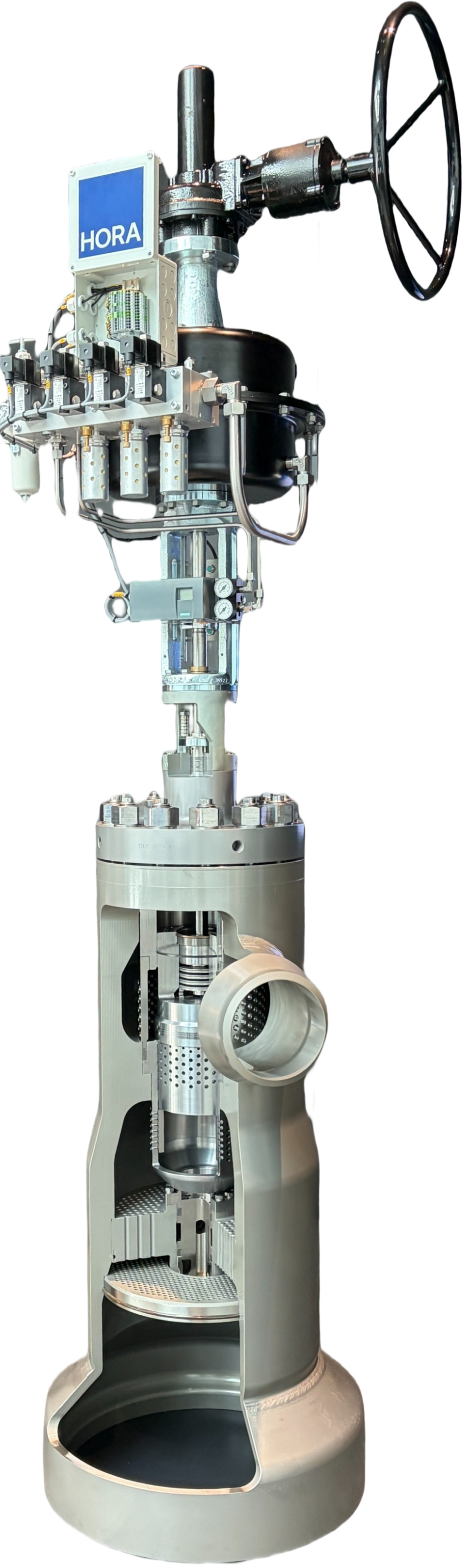
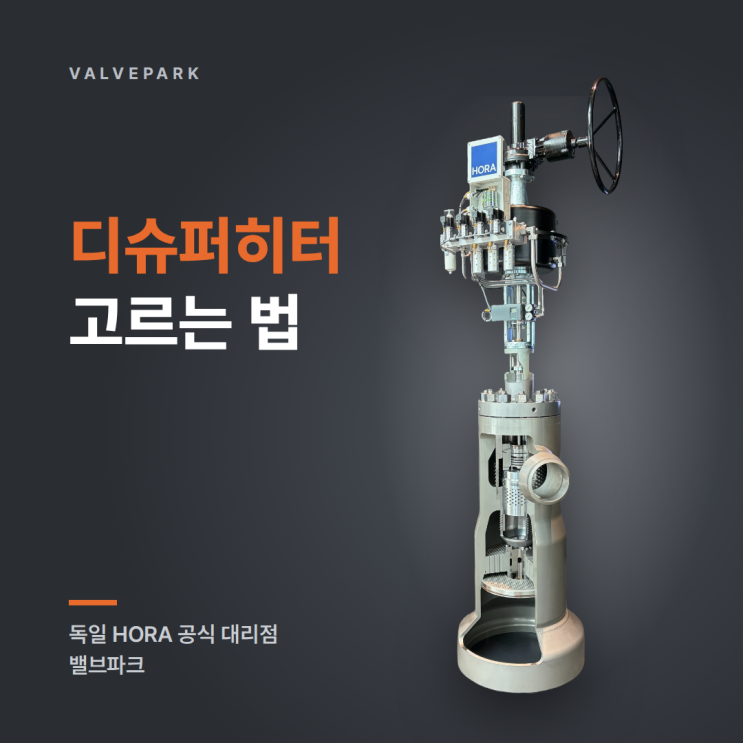
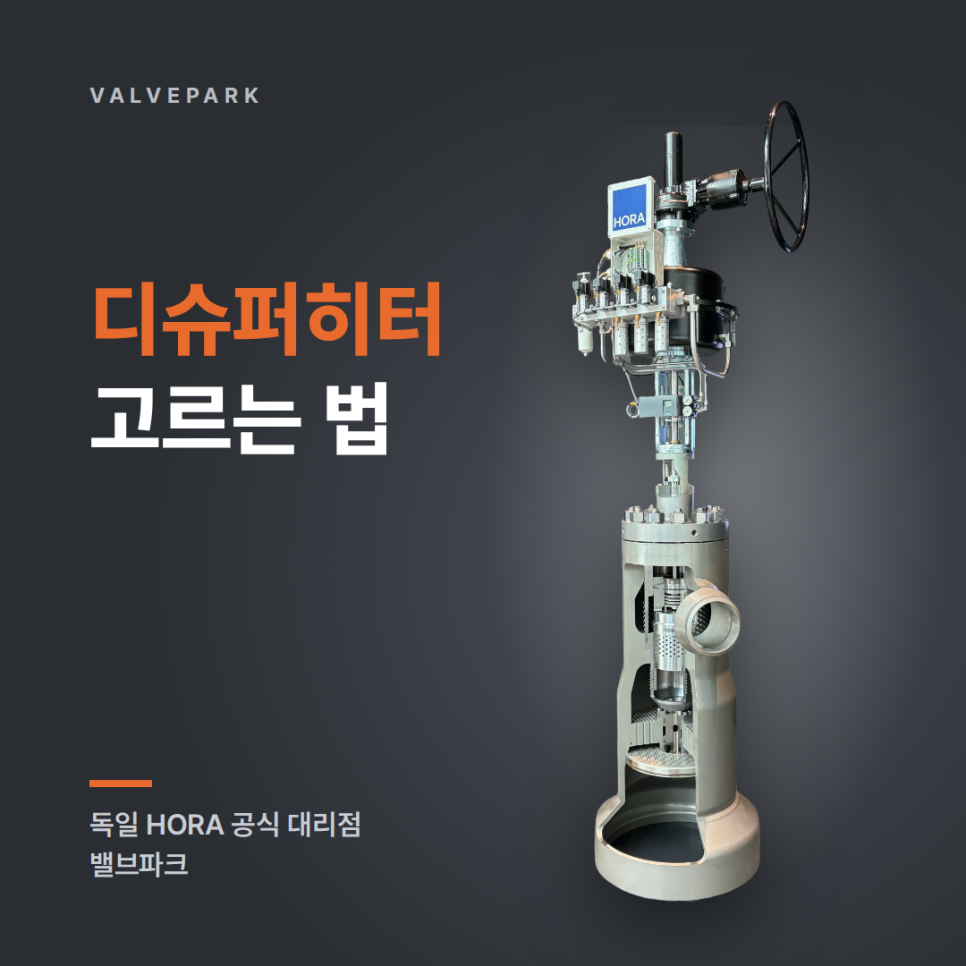
Cutaway of a HORA steam conditioning valve, showing the handwheel and pneumatic actuator on top and the perforated multi-stage cage and outlet diffuser inside the body
HORA is a steam and high-pressure valve manufacturer founded in Germany in 1967, supplying power plants, district heating, and paper and chemical processes. It has delivered turbine bypass valves and desuperheaters even for conditions above 600 °C and 270 bar, such as supercritical thermal power plants in Germany, India and China.
In Korea, VALVEPARK supplied HORA desuperheaters to Company S's power plant in four types: injection lance, steam-assisted, venturi and multi-nozzle. It is a case showing that, even within one plant, the suitable type can differ when each line has different conditions.
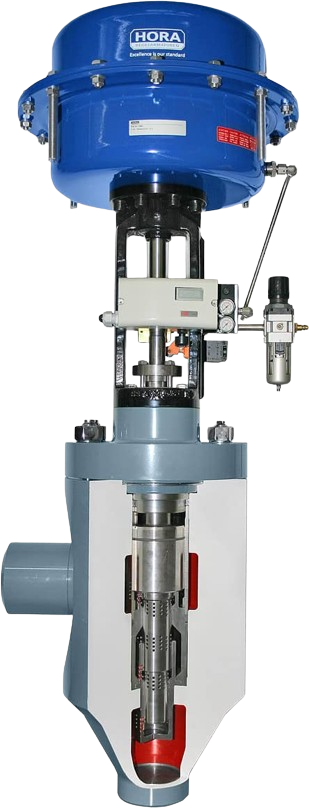
Cutaway of a HORA control valve: below the pneumatic actuator and positioner, steam entering from the side passes through the multi-stage cage and its pressure drops step by step
Give us the operating conditions below and we can start a type and size review with HORA.
1️⃣ Steam flow: minimum, normal and maximum
2️⃣ Inlet steam: pressure and temperature
3️⃣ Target outlet temperature: how many °C above saturation temperature
4️⃣ Cooling water: pressure, temperature and water quality
5️⃣ Piping: size and mounting orientation, straight pipe length after the injection point, and temperature sensor position
6️⃣ Whether pressure reduction is needed: outlet pressure if so
VALVEPARK handles everything from specification consultation to HORA design discussion, import and customs clearance, installation and commissioning support, spare parts and after-sales service. VALVEPARK is also in charge of HORA service support across Asia, so parts supply and fault response are available locally.
When replacing an existing desuperheater, we also check the current model name or a photo of the nameplate. If you need a specification sheet or detailed documents, please contact us.

The supply flow: consultation and specification, HORA design discussion, quotation, import and customs clearance, delivery, commissioning and after-sales service
| Process lines with load variation | HORA Adjustable Injection Desuperheater (integrated control) Injection type that adjusts the spray rate |
| Lines with large load variation | HORA Steam-Atomizing Desuperheater (Cooler 62S) Breaks water into fine droplets with auxiliary steam to cover a wide flow range |
| Pressure and temperature reduction together | HORA Steam Conditioning Valve (integrated spray cooling type) Control valve and spray section in one body |
▸ View product: HORA Desuperheater
https://www.valvepark.com/hora/desuperheater/hora-desuperheater?utm_source=naver_blog&utm_medium=blog&utm_campaign=desuperheater
| Purchase and Inquiries VALVEPARK Official Contact | |
|---|---|
| sales@valvepark.com | |
| Phone | 1666-0215 |
| KakaoTalk Channel | https://pf.kakao.com/_lxftVxj |
| Buying piping materials, made easy and fast. | |
| Product details and purchasing are available at the links below. | |
| Website | https://www.valvepark.com/?utm_source=naver_blog&utm_medium=blog&utm_campaign=desuperheater |
| Smart Store | https://smartstore.naver.com/valvepark?nt_source=naver_blog&nt_medium=blog&nt_detail=desuperheater |