Hello, this is VALVEPARK.
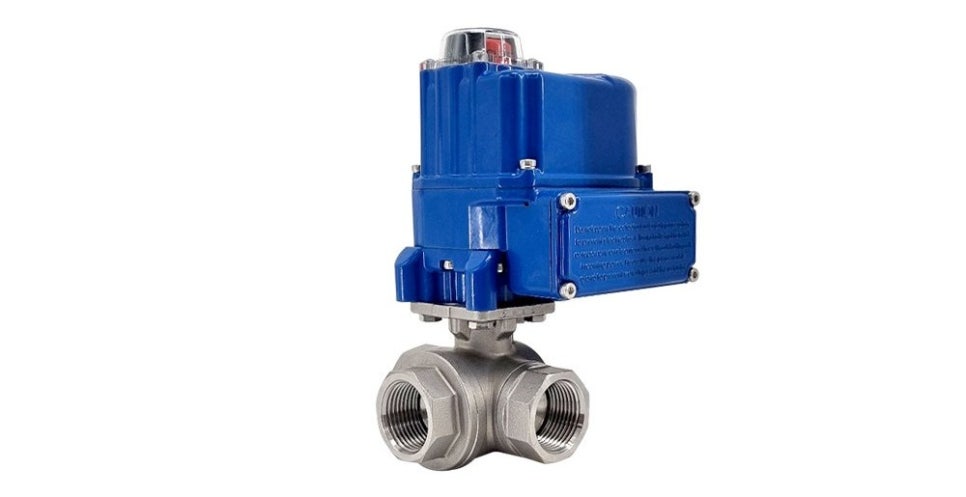
One of the components most often used to control fluid flow on an industrial site is the 3-way valve (a three-port valve).
As the name suggests, it does more than simply open and shut the flow the way an ordinary valve does.
It uses three ports to select or change the direction in which the fluid travels.
Anyone meeting a 3-way valve for the first time, though, runs into one confusing point.
They are both 3-way valves, so what exactly is the difference between a T-port and an L-port?
They can look alike from the outside, but the shape of the flow path bored through the ball inside makes the two behave very differently.
In this technical solution we start with the basic construction of the 3-way ball valve
and then explain how T-port and L-port designs actually redirect the flow, in terms a newcomer can follow.
A 3-way valve is, quite literally, a valve that controls fluid flow through three ports.
Where an ordinary 2-way valve only opens or shuts the flow,
a 3-way valve adds one more route on top of that.
For example, picture a valve with the following three ports.
· Left port
· Right port
· Bottom port
Rotating the ball inside the valve changes which two of those three ports are joined together.
Rather than a simple ON/OFF valve, a 3-way valve is better understood as
"a device that chooses which path the fluid takes"
and once you picture it that way, the rest falls into place.
2. Everything comes down to the 'ball' inside
When you are trying to understand a 3-way ball valve, one thing matters more than its outward shape.
It is the ball that rotates inside the body.
The ball is bored through so the fluid can pass,
and whether that bore is shaped like a T or an L is what decides how the valve behaves.
T-Port ➜ a T-shaped flow path
L-Port ➜ an L-shaped (right-angled) flow path
In a T-port valve the flow path through the ball is arranged in the shape of a T.
As the ball turns, different ports are connected, so the flow can be rerouted or split between outlets.
T-Port before actuation : the fluid runs straight through
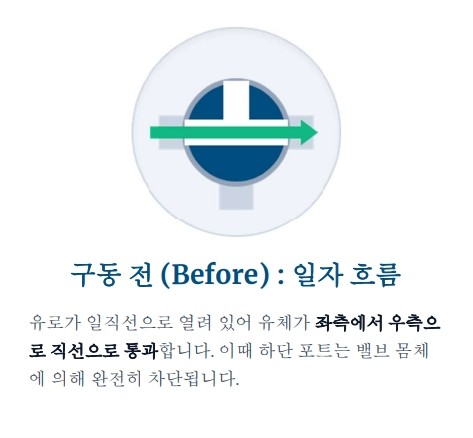
Before the valve is actuated, the internal flow path lines up straight.
The fluid therefore passes straight through, left port → right port.
The bottom port is blocked off in this position.
Put simply, the fluid runs left → right exactly as it would through an ordinary straight run of pipe.
T-Port after actuation : the flow turns through 90 degrees

Now suppose the actuator on the valve operates.
The actuator turns the ball through 90 degrees, and the flow path inside the ball turns with it.
As a result, the left port ↔ bottom port pair is now connected.
The fluid no longer runs straight through: it turns 90 degrees and flows out of the bottom port.
Before actuation
Left → Right
After actuation
Left → Bottom
In an L-port valve the internal flow path is formed as an L, a single right-angled bend.
Unlike the T-port, the L-port is best understood as a device for switching the flow from one route to the other.

L-Port before actuation : flow runs from the bottom to the left
With the L-port in one position, the bottom port ↔ left port pair is connected.
The fluid can therefore flow bottom → left.
The right port is blocked in this position.
All three ports are never joined at once: the L-shaped bore links exactly two of them.
L-Port after actuation : the flow switches to the opposite side
When the actuator turns the ball through 90 degrees, the internal flow path changes direction with it.
This time the bottom port ↔ right port pair is connected.
The original bottom → left flow therefore becomes bottom → right.
The important point is that an L-port does not connect three ports in a straight line.
It picks up the flow from one side and diverts it to the other
| Item | T-Port | L-Port |
|---|---|---|
| Internal flow path | T-shaped | L-shaped (right-angled) |
| Main purpose | Rerouting and splitting the flow | Switching the flow direction |
| Before actuation | Straight-through flow | Right-angled flow |
| After actuation | Turns through 90° | Switches to the opposite side |
| Key characteristic | Reroutes and splits the flow | Selects the flow direction |
| In plain terms | Distributing type | Switching type |
What to check when selecting a 3-way valve
When selecting or replacing a 3-way valve in the field, it is best to work through the following checks in order.
1. How many ports does it have?
➜ Confirm that it really is a 3-way valve
2. What shape is the internal flow path?
➜ Check whether it is T-port or L-port
3. Which ports are connected before actuation?
➜ Check the flow path in the home position
4. How does that connection change after actuation?
➜ Check the direction it actually switches to
5. Does it match the flow path your equipment requires?
➜ Compare it against the system conditions as a final step
※ Working through these steps avoids the common mistake of choosing a valve on appearance or model name alone.
We hope this article has made the working principle of the 3-way valve a little clearer.
We will keep unpacking how different valves and fluid control solutions work, one at a time,
staying technically accurate while keeping it readable for anyone new to the subject.