Hello, this is VALVEPARK.
In Part 1, we looked at the difference between rack and pinion and scotch yoke, the two typical structures of pneumatic actuators.
This time we will look at another important way of classifying pneumatic actuators.
That is double acting versus single acting (spring return).
The biggest difference between the two is simple.
Does the actuator use air pressure for both opening and closing the valve?
Or does it use air pressure in one direction and a spring in the other?
This goes beyond a simple difference in structure. It determines how the valve moves when the air supply is lost, which makes it very important in safety design.
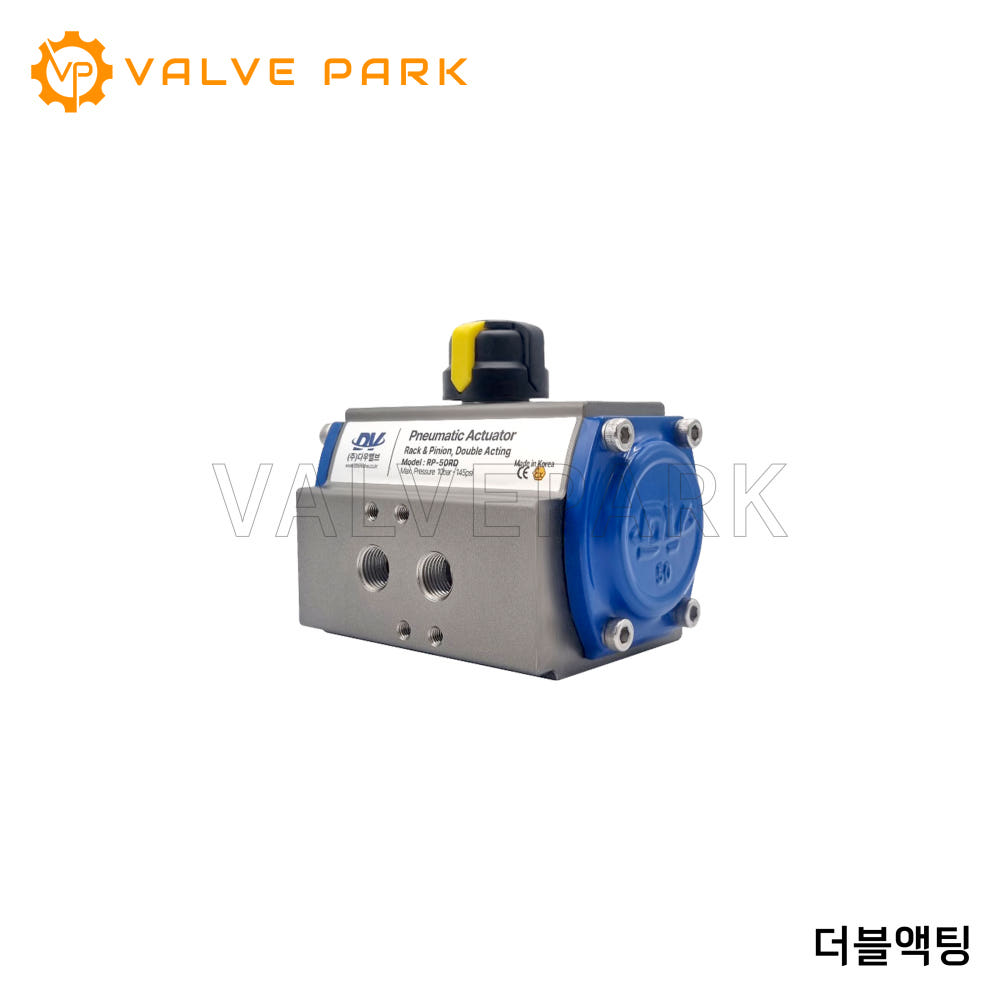
A double acting actuator uses compressed air in both directions, to open and to close the valve.
When air is supplied to one port, the piston moves in one direction, and when air is supplied to the opposite port, it moves back the other way.
In other words, compressed air opens the valve, and compressed air supplied in the opposite direction closes it.
The operating sequence, in brief, is as follows.
Both of the two holes you can see in the photo are used.
Compressed air supplied to one hole → piston moves → actuator rotates → valve opens
Compressed air supplied to the other hole → piston moves the opposite way → actuator rotates in reverse → valve closes
So the essence of the double acting type is that both the opening and the closing of the valve can be controlled with compressed air.
✓ Driven by air pressure in both directions
✓ Uses both ports
✓ Relatively high air consumption
✓ Can be smaller than a single acting unit for the same torque
✓ Generally less expensive than single acting
✓ Used with a 5/2-way solenoid valve
✓ Applied to large-bore and high-torque valves, among others
However, it has no spring to return the valve automatically to a set position when the air supply is cut off, so by default it has no fail-safe function.
※ Fail-safe is a function that moves the valve to a predetermined safe position when an emergency occurs, such as loss of air pressure or power.
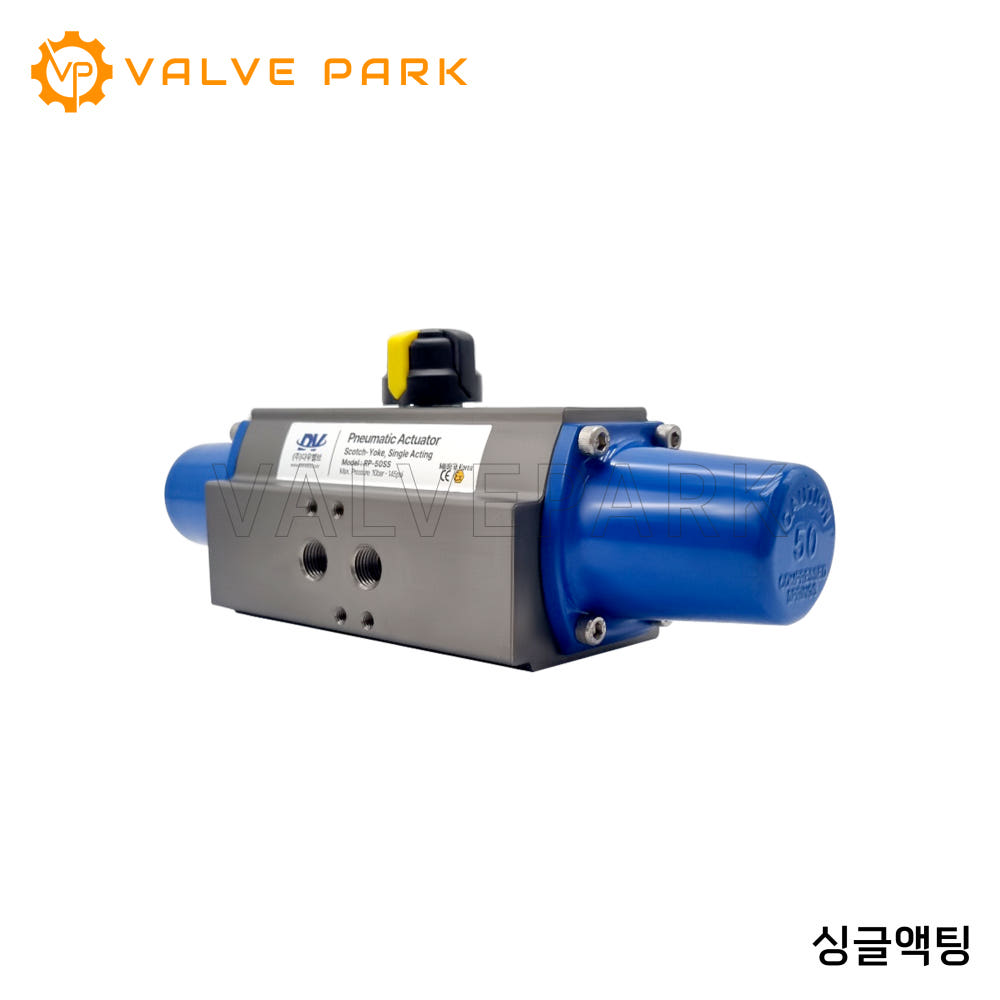
Unlike the double acting type, a single acting actuator uses air pressure in one direction and the restoring force of a spring in the other.
For example, imagine the valve is being held open by air pressure.
What happens if the air supply is suddenly lost?
In a single acting actuator, the internal spring acts and returns the valve to a predetermined position.
It is because of this function that single acting actuators are widely used in equipment where safety is important.
To understand a single acting actuator, you need to know about the fail position.
The fail position can be summed up in one simple question:
Where should the valve go when the air supply is lost?
There are three typical options.
FC: Fail Close
The valve closes when the air supply is lost.
FO: Fail Open
The valve opens when the air supply is lost.
FL: Fail Last
The valve holds its last position even when the air supply is lost.
Which option to choose must be decided according to the safety requirements of the equipment and the process.
On an industrial site, it is not enough to consider normal operating conditions only.
You also have to think about situations such as a sudden power failure or a problem with the compressed air supply.
You need to decide in advance whether it is safe for the valve simply to stay where it is, or whether it should be closed, or opened.
For example, in some processes it is safer to close the valve in an emergency, while in others it may be safer to open it.
So when selecting a single acting actuator, the first thing to decide is not just "how many Nm of torque?" but which direction the valve must move in when the air supply is lost.
Torque also needs to be checked more carefully for single acting actuators.
There is one more important point about single acting actuators.
Because of the spring, the torque is not constant.
For the air stroke you need to check Air Start / Air End, and for the spring return stroke you need to check Spring Start / Spring End.
The resistance of the spring can change with the operating position, so each torque value has to be checked separately.
When selecting a single acting actuator, rather than deciding on a single rated torque figure, it is important to compare each of the four torque values with the valve's required torque.
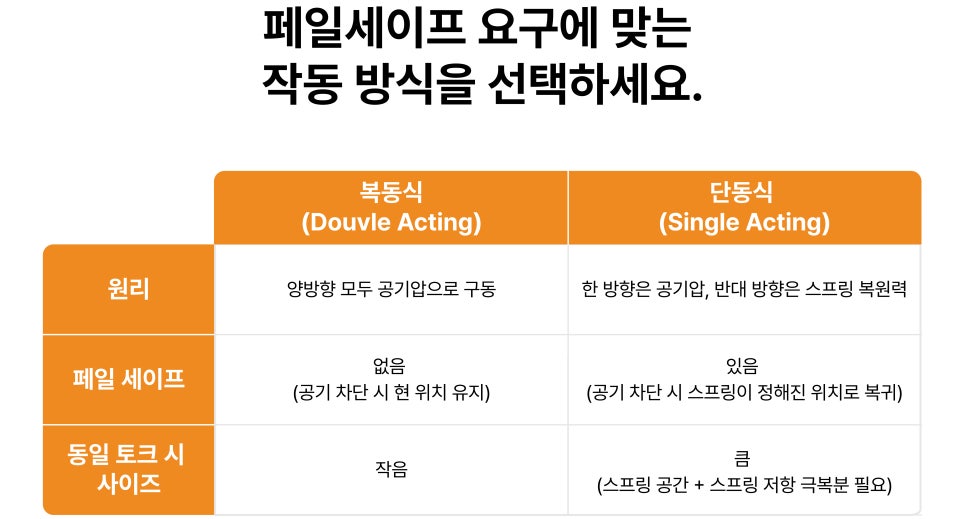
Double acting vs single acting comparison
| Item | Double acting | Single acting |
|---|---|---|
| Operating principle | Air pressure in both directions | Air pressure + spring |
| Air supply | Both ports | One port |
| Air consumption | Relatively high | Relatively low |
| Fail-safe | No | Yes |
| For the same torque | Relatively small size | Relatively large size |
| Solenoid | 5/2-way | 3/2-way |
| Main applications | Large-bore, high-torque | Safety-related lines, ESD and similar |
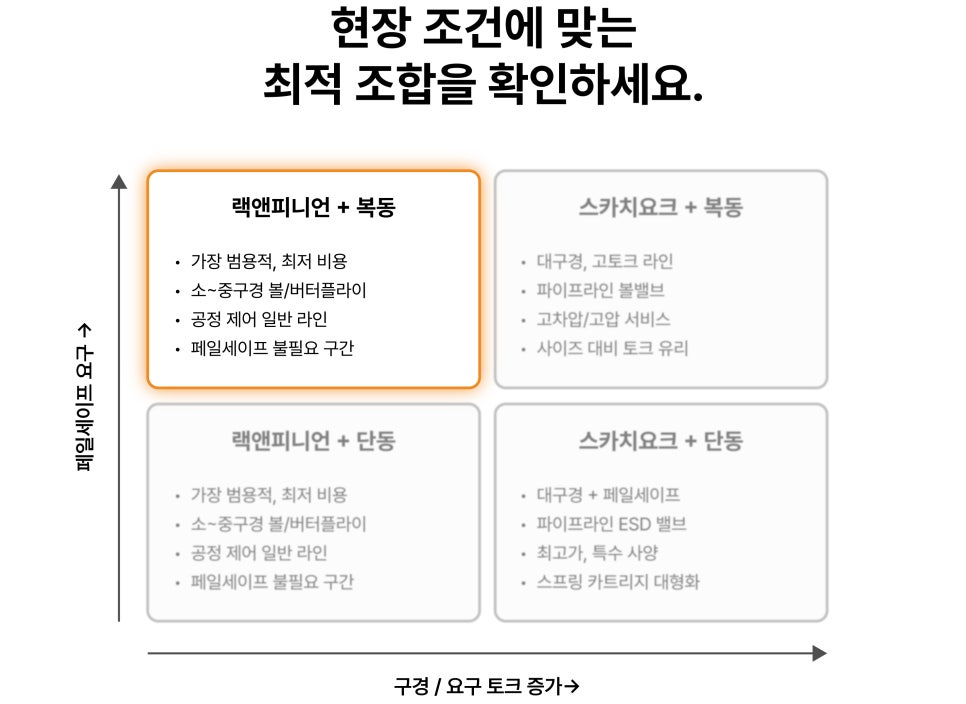
When you want to control both directions with air pressure
When there is no need for automatic return to a set position if the air supply is lost
➜ Double acting is recommended
When the valve must move to a specific safe position if the air supply is lost
➜ Single acting is recommended
Especially in equipment where valve action in an emergency is critical, such as ESD, the fail position should be reviewed first.
When actually selecting an actuator, it is a good idea to check the following five points.
① Valve break torque
Check the torque needed when the valve actually starts to move, and apply a safety factor of 25 to 30%.
② Supply air pressure
Selection is generally reviewed on the basis of 4 to 6 bar, but the final choice must be rechecked against the actual supply pressure on site.
③ Fail position
For a single acting unit, decide which of FC, FO or FL suits the process.
④ Mounting standard
Check the ISO 5211 flange and the stem shape to make sure the actuator and valve fit together correctly.
⑤ Operating environment
Also check the operating temperature, corrosive conditions, explosion-proof rating, and the moisture and oil quality of the compressed air.
The difference between double acting and single acting is not simply a matter of whether there is a spring inside.
The key questions are what the valve must do when the air supply is lost, and whether the actuator can deliver enough of the torque the valve actually needs across the entire stroke.
In the end, selecting a pneumatic actuator means reviewing the valve's required torque + supply air pressure + fail position + installation conditions + operating environment together.
Simply choosing a bigger actuator does not make it a better choice.
What matters most is selecting exactly the right product for the valve's actual operating conditions.
If you find the selection difficult, please contact VALVEPARK.