
When you look at valve automation equipment, you will often come across a device called a pneumatic actuator.
It is a device that uses compressed air to open and close a valve automatically.
But did you know that pneumatic actuators come in several different designs?
The two most widely used types are rack and pinion and scotch yoke.
From the outside, both are devices that move a piston with compressed air to rotate a valve, but they differ in how they convert the piston's linear motion into rotary motion, and in their torque characteristics.
Today we will explain the difference between these two types in simple terms.
Let us start with the basic principle.
When compressed air is supplied into a pneumatic actuator, the piston moves in a straight line.
However, most valves open and close by rotating, so the piston's linear motion cannot be used as it is.
That is why the direction of motion is converted inside the actuator.
Depending on which mechanical structure is used in this process, actuators are divided into rack and pinion and scotch yoke types.
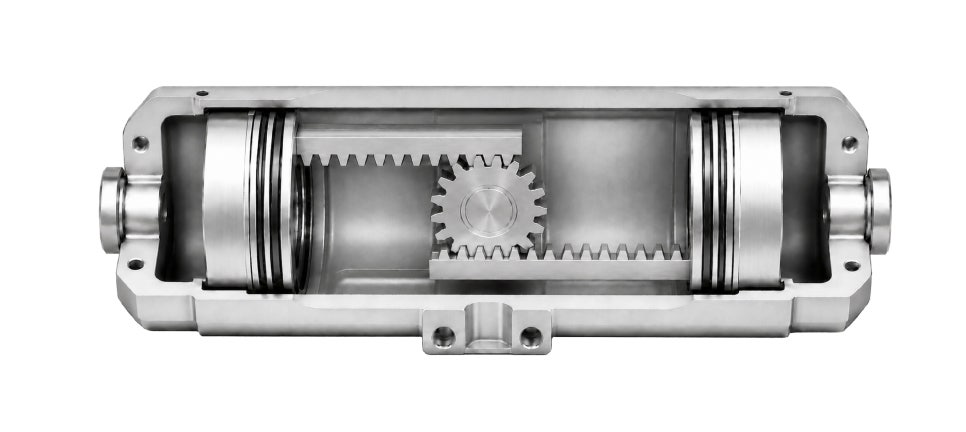
As the name suggests, the rack and pinion type uses a rack gear and a pinion gear.
When the piston moves in a straight line, the rack gear attached to it moves along with it, and the pinion gear meshed with the rack rotates.
The valve stem is connected to this pinion, which opens and closes the valve.
Put simply in one sentence:
A gear moving in a straight line turns a rotating gear
A rack and pinion actuator delivers relatively constant torque across the entire stroke.
Because its structure is relatively simple, it is also easy to maintain and has good compatibility with accessories.
For these reasons it is widely used on general-purpose rotary valves such as standard ball valves and butterfly valves.
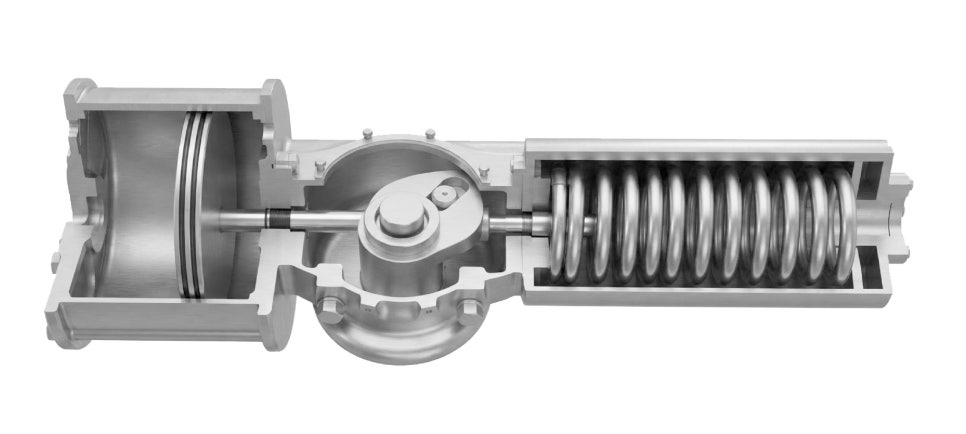
A scotch yoke converts linear motion into rotary motion in a slightly different way from rack and pinion.
A sliding pin connected to the piston moves along a slot machined in the yoke, and this rotates the yoke.
A pin pushes a rotating plate around
That is a good way to picture it.
However, what really sets the scotch yoke apart is not its structure but its torque characteristic.
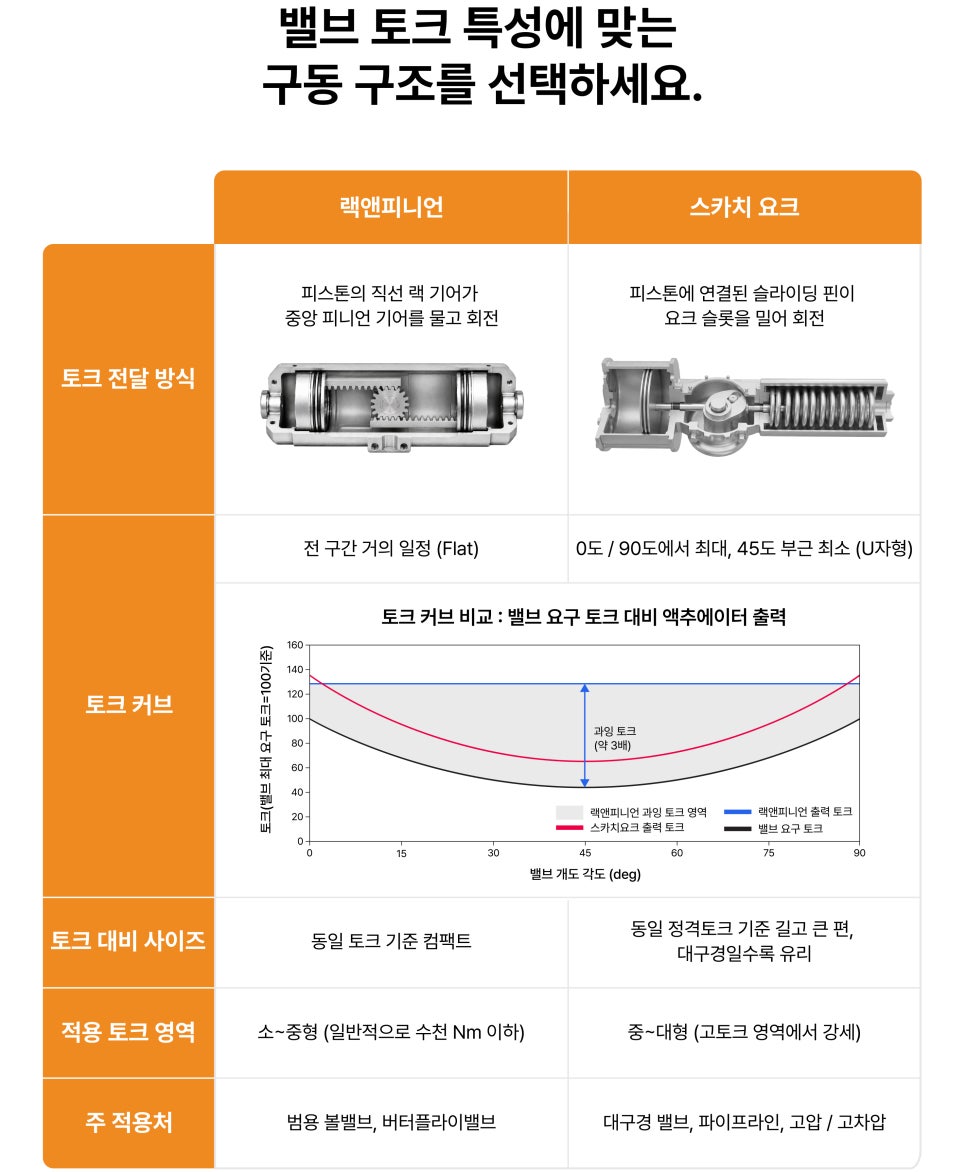
A scotch yoke generally has a U-shaped torque curve: high torque near 0° and 90°, and relatively low torque near 45°.
This is where the heart of pneumatic actuator selection lies.
When choosing an actuator, many people tend to think like this:
The valve needs 500 Nm, so I can just pick a 500 Nm actuator, right?
In practice, though, the torque a valve requires can change with its angle of travel.
Ball valves and butterfly valves in particular can need high torque at the moment the valve starts to open and at the moment it fully closes.
This is where Break To Open and Break To Close become important.
These terms mean that more force may be needed when the valve first starts to move and when it finally closes.
A scotch yoke produces high torque near 0° and 90°.
This characteristic can match the torque demand curve of the valve well.
A rack and pinion actuator, on the other hand, produces relatively constant torque across the entire stroke.
So if you size the actuator to the valve's maximum required torque, it may produce more torque than is actually needed at mid-travel.
In simple terms, the larger the valve, the more force it needs when it starts to move or when it closes, and because a scotch yoke can deliver high torque in exactly those ranges, it can be a good fit for large-bore, high-torque valves.
It is not simply a question of which actuator is stronger.
What matters is how well the torque the valve needs matches the shape of the torque the actuator produces.
| Item | Rack and pinion | Scotch yoke |
|---|---|---|
| Torque characteristic | Relatively constant across the stroke | High at 0° and 90°, low at 45° |
| Structure | Rack and pinion gear mechanism | Pin and yoke mechanism |
| Application | General-purpose valves | Large-bore, high-torque valves |
| Size | Compact for the same torque | Relatively large |
| Maintenance | Relatively simple | Requires specialist maintenance |
| Price | Relatively low | Relatively high |
Here is a simple summary.
Standard ball valves / butterfly valves ➜ rack and pinion recommended
Large-bore valves / high-torque pipelines ➜ scotch yoke recommended
But this is only a general direction.
In real actuator selection, the valve's required torque and the actuator's output torque must be compared across the entire range of travel.
It is especially important to check the valve's Break To Open and Break To Close torque and to secure an adequate safety factor.
To sum up the difference between rack and pinion and scotch yoke in one sentence:
while scotch yoke is a structure well suited to producing high torque in the ranges where it is needed.
So when choosing an actuator, rather than simply comparing size or rated torque, you should check how the valve's torque characteristic and the actuator's torque curve fit together.
In the next part, we will look at another important way of classifying pneumatic actuators: double acting and single acting.
We hope this article has made the difference between rack and pinion and scotch yoke a little easier to understand.
We will keep sharing technical information that is useful in the field.