Reading order: legend, medium name, concentration and temperature, cross-checking sources
Rubber by medium: EPDM for water, steam and alkali; NBR for oil and fuel; Viton for acids, oil and hydrocarbons; silicone for food and beverage
Where sources differ: Viton with steam and alkali, and the several media grouped in the solvent column
Inquiry details: medium name and concentration, operating temperature, O-ring size
Hello, this is VALVEPARK.
Use the ◎○△× in a chemical resistance chart to screen candidate materials, and decide the material only after matching the medium name, concentration and temperature.
When a cleaning solution or solvent changes, an O-ring material chosen for the previous medium may no longer suit it, and the O-ring can swell or harden. Changing the material based only on the grade in the chart can bring back the same symptoms.
This article covers four rubbers, EPDM, NBR, Viton (FKM) and silicone, and sets out the order for reading the chart and the points where the media split.
Only as far as screening candidates. A chart is a general guideline that matches only medium names to materials, so it cannot capture the concentration, temperature and contact time at your site.
To avoid fixing a material from a single chart, look at the following four points in order.
1️⃣ Legend: the meaning of the symbols differs from chart to chart. In some charts ◎ is the best, while others use × for "withstands" and ○ for "does not withstand", and some use numeric grades where 1 is the best and 4 is poor.
2️⃣ Medium name: one "solvent" column groups several media, so a material suited to toluene may not suit acetone. A blank cell means "no data", not "no problem".
3️⃣ Concentration and temperature: some charts split rows by concentration, as with acetic acid or nitric acid, and some charts state the temperature on the steam row, so look at the row closest to your conditions. A pH value alone cannot decide the material, so you need the medium name and the concentration (%).
4️⃣ Cross-checking sources: even for the same Viton, the compound differs by fluorine content and cure system, so the grades differ from chart to chart. Do not decide from one chart; match two or more sources.

One rating chart, and the temperature, concentration and contact time that must be weighed outside the chart
Screen with the chart, confirm with the conditions
Water, steam and alkali go to EPDM, oil and fuel to NBR and Viton, and food and beverage to silicone. This is the use per the catalog.
From the grades per the catalog, only the media needed for this article are selected and summarized.
| Medium | NBR | EPDM | Viton (FKM) | Silicone |
|---|---|---|---|---|
| Water | Excellent | Excellent | Excellent | Good |
| Oil | Excellent | Poor | Excellent | Poor to Good |
| Solvent | Fair | Poor | Good (excluding ketones and esters) | Fair |
| Strong acid | Poor | Good | Excellent | Poor |
| Strong alkali | Good | Excellent | Varies by source | Good |
NBR: excellent for water and oil, good for strong alkali, fair for solvent, poor for strong acid
EPDM: excellent for water and strong alkali, good for strong acid, poor for oil and solvent
Viton (FKM): excellent for water, oil and strong acid, good for solvent (excluding ketones and esters), and strong alkali varies by source
Silicone: good for water and strong alkali, fair for solvent, poor to good for oil, poor for strong acid
The media that the general chart in the catalog does not recommend are hydrocarbons, oils and fats for EPDM, and solvents, benzene and xylene for NBR. For silicone they are steam, solvents and hydrocarbons, and for Viton steam, ketones, esters and so on. Because Viton's grades for solvents and alkali differ by source, the table lists solvent as "Good (excluding ketones and esters)" and alkali as "Varies by source".
If the medium does not suit, the O-ring can absorb the medium and swell, or harden and crack. Even O-rings of the same size can thicken on one side depending on the medium.

Two O-rings of the same size soaked in two different media, with only the one on the right swollen thick
If you tell us the medium name, concentration and temperature, we suggest a match including the O-ring material. The configurations for each range, from centering rings and O-rings for vacuum flanges to gaskets for hygienic piping and exhaust valves for corrosive gas, are below.
| Vacuum flange, oil, hydrocarbons and general process gas | Vacuum centering ring and O-ring (SUS304, VITON) Set of a Viton (FKM) O-ring and a SUS304 centering ring |
| Corrosive gas exhaust line | HTC Teflon-coated vacuum valve Internal Teflon coating, FFKM O-ring by requested specification |
| Organic solvents (excluding ketones and esters) and high-temperature hygienic lines | Sanitary wing gasket (Viton) Tri-clamp connection, wing type |
| Strong solvent and strong acid hygienic lines | Sanitary gasket (Teflon) PTFE material, for ranges that elastomers struggle to handle |
| Food, dairy and pharmaceutical hygienic lines | Sanitary wing gasket (silicone) Tri-clamp connection, wing type |
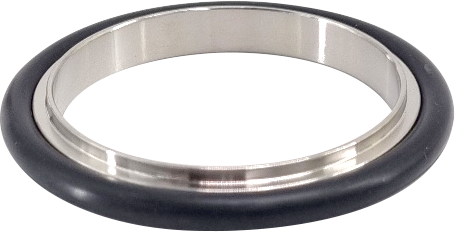
Vacuum centering ring and O-ring (SUS304, VITON): KF and ISO vacuum flanges
Viton (FKM) is widely used for the O-rings of KF and ISO vacuum flanges, and it is a material suited to oils, hydrocarbons and most process gases. A SUS304 centering ring and a Viton O-ring make one set, and the sizes correspond to KF (NW) and ISO flanges.
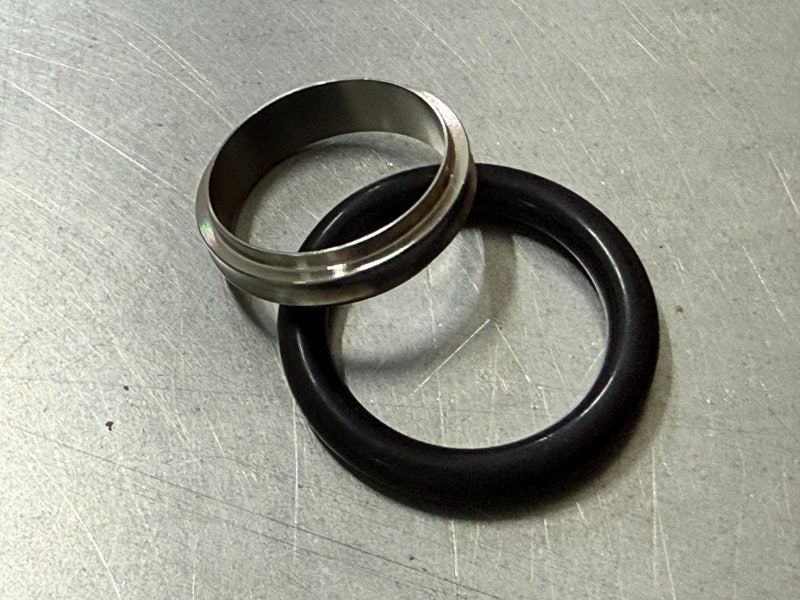
A photo of a SUS304 centering ring and an O-ring placed side by side
Composition: set of a SUS304 centering ring and a Viton (FKM) O-ring
Parts used together: KF hinge clamp (aluminum, double pin), attached and removed without tools by a wing nut
Limit: some fluorine-based and chlorine-based corrosive gases in deposition and etching processes are hard for Viton to handle, so review a higher-grade material such as FFKM
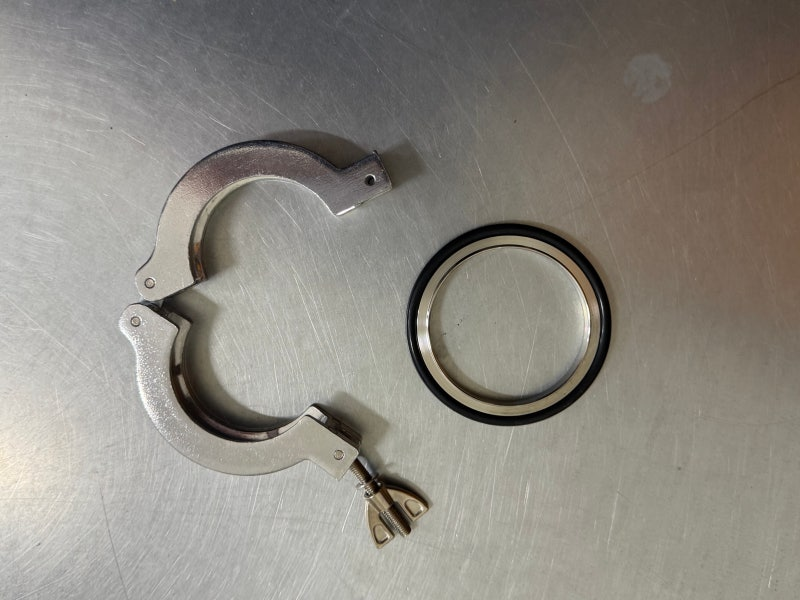
A centering ring and O-ring set beside an open hinge clamp
HTC Teflon-coated vacuum valve: corrosive gas exhaust lines
When corrosive gas flows in an exhaust line, not only the O-ring but also the inner surface of the valve body comes into contact with the medium. This valve has the inside of a 304 stainless steel body coated with Teflon, and per the catalog the coating layer does not absorb water or chemicals. Per the catalog, the continuous operating temperature inside and outside the valve is up to 120℃, and it is not suited to lines above this value.
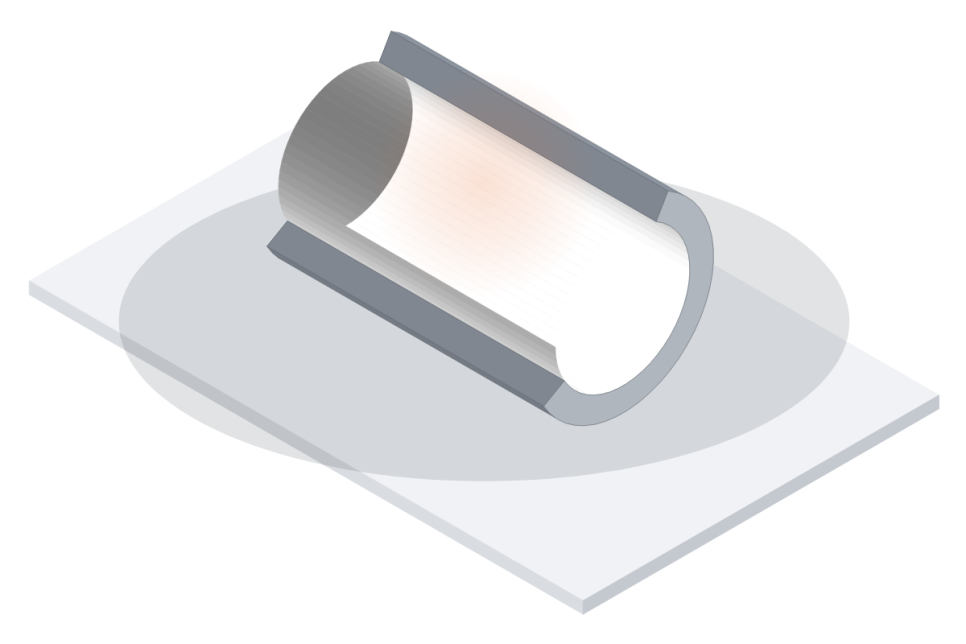
A cross-section with a white coating layer on the inside of the stainless steel body
Seal: the poppet seal is Viton, and other materials and FFKM O-rings are by requested specification
Connection and pressure: KF and ISO flanges, operating pressure 1 atm to 1×10⁻⁷ mbar
Sanitary gaskets (Viton, silicone, Teflon): tri-clamp hygienic piping
On a tri-clamp connection, only the gasket material changes within the same standard to suit the medium. The Viton wing gasket is used for organic solvents (excluding ketones and esters) and high-temperature lines that EPDM struggles to handle, and the Teflon (PTFE) gasket for ranges that elastomers struggle to handle. The silicone wing gasket is for food, dairy and pharmaceutical lines.
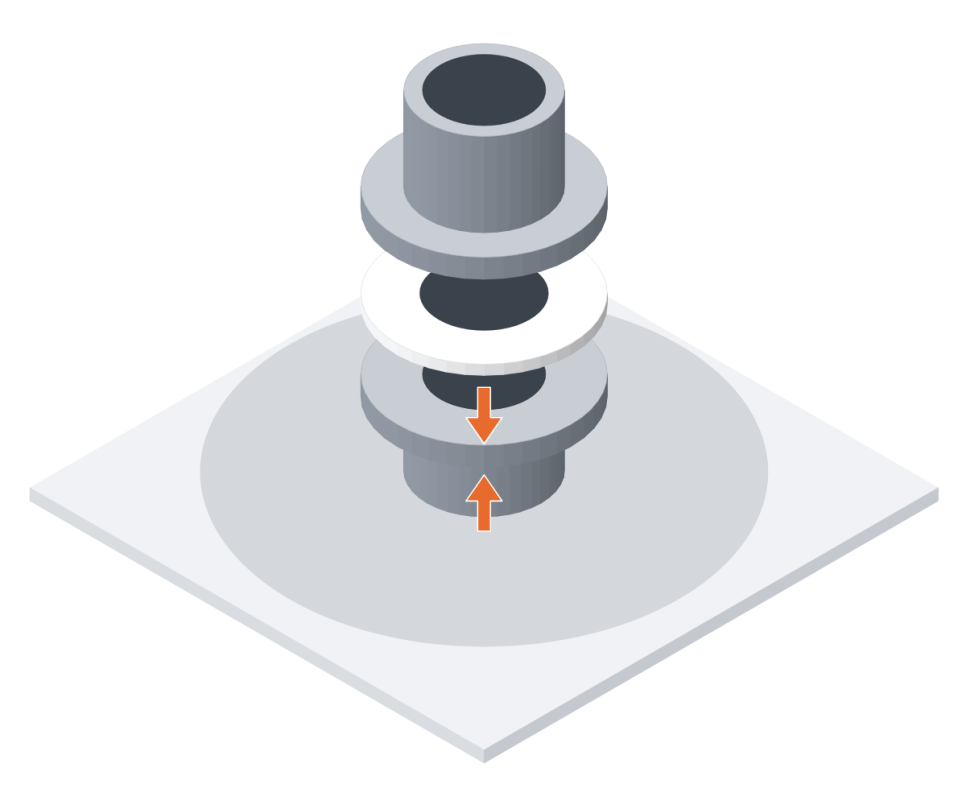
An exploded view of a tri-clamp connection with a gasket between two ferrules
Standard: tri-clamp standard sizes; the wing type fixes the assembly position with an anti-slip ridge
Note: Teflon has weak resilience, so check the tightening torque and the replacement interval
Note: for lines with steam sterilization or alkaline cleaning, check EPDM before Viton
Q. Can an NBR O-ring be used on an IPA cleaning line?
It is conditional. In some chemical resistance charts NBR is at a conditional grade while EPDM and Viton are on the side that withstands it, but in some charts the Viton cell is blank. Decide after checking the cleaning solution concentration and temperature and the contact method (wiping or immersion).
Q. Can Viton be used on a steam line?
We lean toward not recommending it. Per the catalog, steam is left out of the recommended media for Viton, and EPDM is classified as the suitable material for steam and alkali lines. Some material lists Viton for steam in static seals of a sanitary water system, so it varies with the compound and the steam conditions; decide after checking the steam temperature and the number of cycles.
Q. Why does the O-ring harden after a few months when the chart says ◎?
This is because ◎ is a grade for withstanding the medium and does not mean there is no compression set, in which the ring hardens in its compressed shape. Compression set depends greatly on temperature and grows the longer the ring stays compressed. If the cleaning solution concentration rises or two or more media mix, the result can differ from the single-medium grade in the chart, so consider the temperature, contact time and medium conditions together.
Q. Can O-rings in materials other than Viton also be obtained?
It is possible, but an MOQ (minimum order quantity) may apply depending on the request, so please contact us. VALVEPARK looks into other materials such as FFKM or EPDM as far as possible to match your requested conditions.
If you send the information below, we can start a specification review that includes the O-ring material.
1️⃣ Medium: name and concentration (%), and the mixing ratio if two or more are mixed
2️⃣ Temperature: continuous and peak temperature
3️⃣ Contact method: continuous contact, contact only during cleaning, and whether steam sterilization is used and how often
4️⃣ Current O-ring: material and symptom (swelling, hardening, cracking), and replacement interval
5️⃣ Size: KF designation or inner diameter × thickness, and connection type (KF, ISO, tri-clamp and so on)
6️⃣ Quantity
Please contact us if you need a specification sheet or detailed materials.
▸ View product: Vacuum centering ring and O-ring (SUS304, VITON)
▸ See also: Sanitary wing gasket (Viton)
Purchase and Inquiries
| sales@valvepark.com | |
| Phone | 1666-0215 |
| KakaoTalk channel | KakaoTalk consultation |
| Website | Go to the VALVEPARK website |
| Smart Store | Go to the VALVEPARK Smart Store |