304 versus 316: the 316 family contains 2 to 3% molybdenum and 304 contains none
316 versus 316L: the carbon upper limit drops from around 0.08% to 0.03%
Designation comparison: ASTM, DIN and UNS alongside JIS and KS, organized in tables by forging, plate, pipe and casting
Selection criteria: consider 316L for chlorides, welding and high-purity conditions, while 304 is widely used for general hygienic lines
Inquiry details: drawing designation, medium, chlorides, temperature, whether welded, and size
Hello, this is VALVEPARK.
Even when drawing designations differ, comparing them lets you decide which of SUS304, SUS316 and SUS316L to order. KS, JIS, ASTM and DIN each call the same stainless steel by a different name.
Overseas equipment drawings may read "A182 F316L", "1.4404" or "CF8M", while domestic purchase orders often read "SUS316L". Purchasing staff and equipment engineers at food, pharmaceutical, biotech and secondary battery plants often have to match these designations when ordering from drawings.
The designations and values below cover only the three grades 304, 316 and 316L. Composition ranges differ slightly by standard, so saying that designations correspond is not the same as saying the compositions are identical.
The difference between 304 and 316 is molybdenum (Mo), and the difference between 316 and 316L is carbon (C).
The 316 family contains 2 to 3% molybdenum and 304 contains none. Molybdenum acts to lower the tendency toward pitting (corrosion in the form of small holes) on the surface.
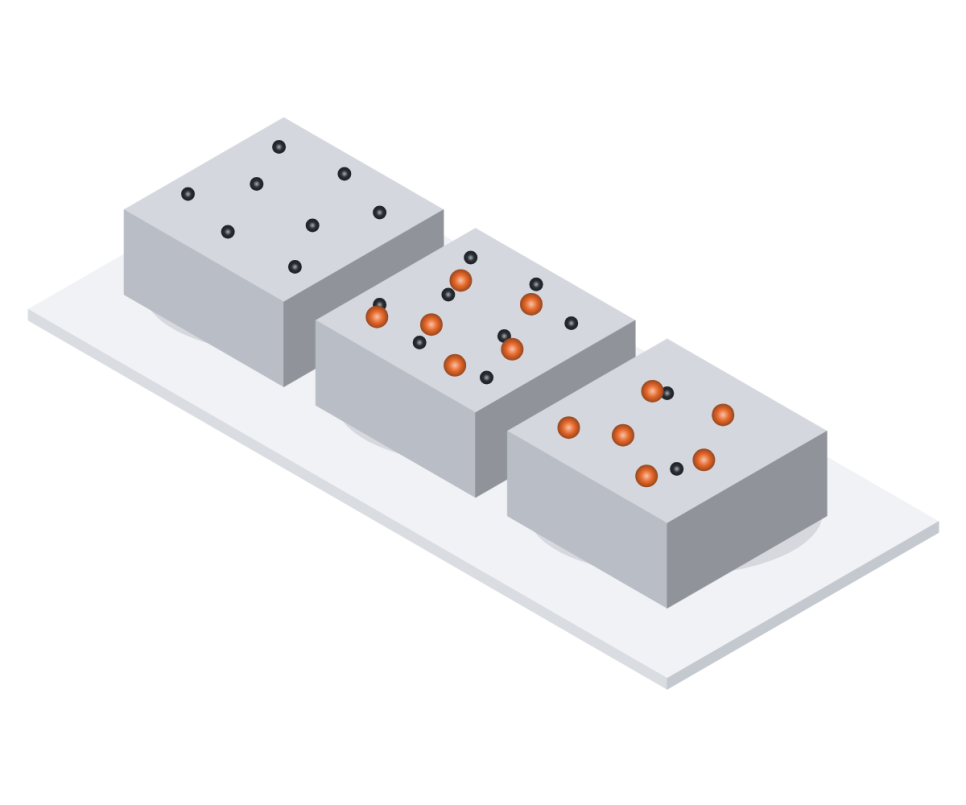
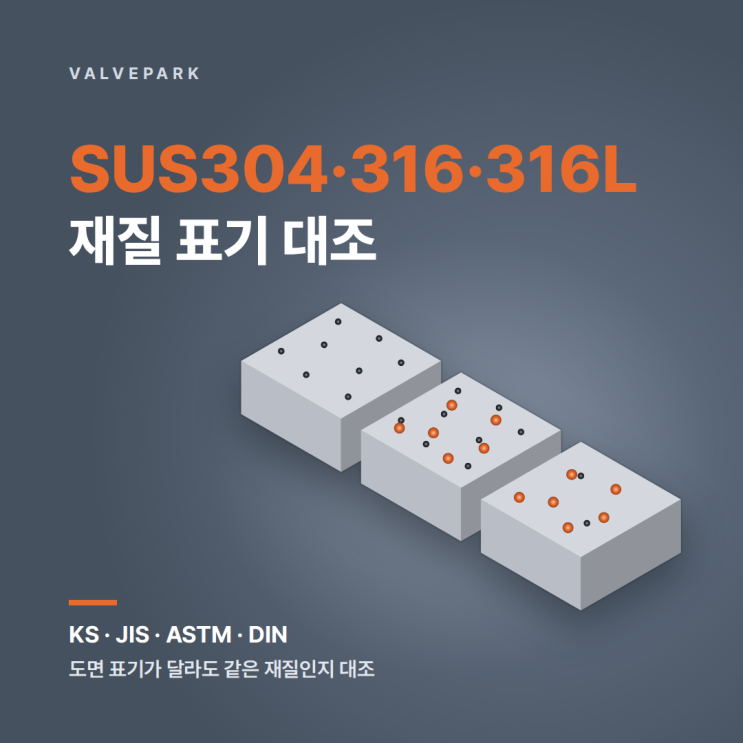
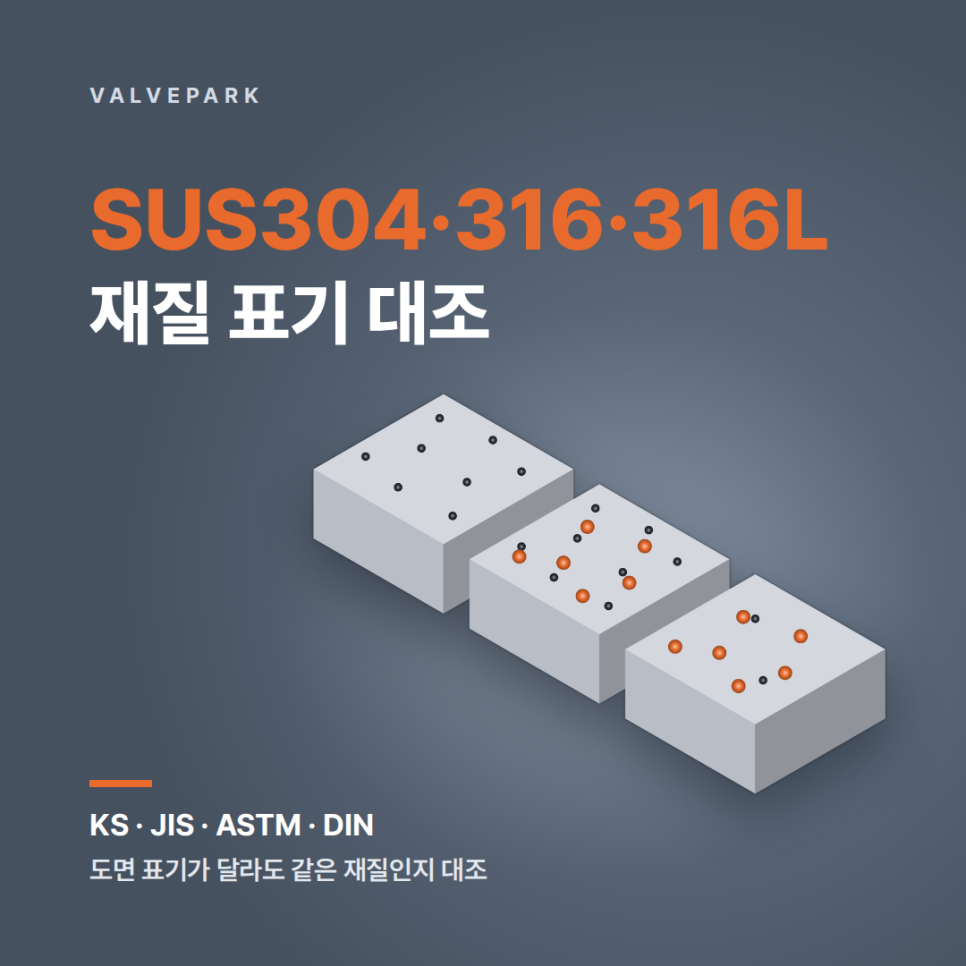
From the left: 304, 316 and 316L. A conceptual diagram in which black grains stand for carbon and orange beads for molybdenum; the sizes and numbers are not actual contents
L stands for low carbon. The carbon upper limit for 304 and 316 is 0.07 to 0.08% depending on the standard, and for 316L it is 0.03%. With less carbon, sensitization, in which the area that received welding heat becomes vulnerable to corrosion, is reduced.
316 is molybdenum, 316L is low carbon
Which Material on a Purchase Order Do A182 F316L, 1.4404 and CF8M on a Drawing Correspond To?
A182 F316L and 1.4404 belong to the SUS316L family, and CF8M is the designation for a cast 316-family product.
Even within the 316 family, forgings (parts made by hammering), plate, pipe and castings (bodies made by pouring molten metal) each have their own standards. That is why a drawing may list CF8M for the body, F316 for the flange and TP316 for the piping together. CF8 is the cast designation for 304 and not a designation for wrought material.
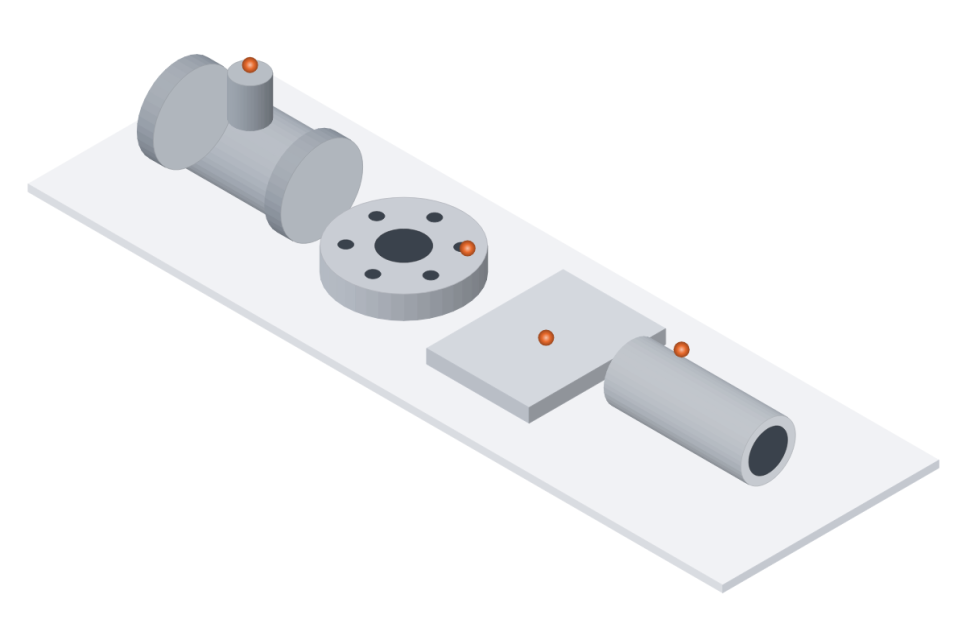
A cast body, forged flange, plate and pipe. Even the same 316 family is called by different standards depending on the form
First, the designations on overseas drawings.
| Category | 304 | 316 | 316L |
|---|---|---|---|
| ASTM forging | A182 F304 | A182 F316 | A182 F316L |
| ASTM plate | A240 304 | A240 316 | A240 316L |
| ASTM pipe | A312 TP304 | A312 TP316 | A312 TP316L |
| ASTM casting grade | CF8 | CF8M | CF3M |
| DIN (EN) forging, plate, pipe | 1.4301 | 1.4401 | 1.4404 |
| DIN (EN) casting | 1.4308 | 1.4408 | 1.4409 |
| UNS | S30400 | S31600 | S31603 |
Next are the JIS and KS designations used on domestic purchase orders. The bar stock and cast rows and the JIS designations for forgings are per the catalog.
| Category | 304 | 316 | 316L |
|---|---|---|---|
| Pipe | SUS304TP (JIS), STS304TP (KS) | SUS316TP (JIS), STS316TP (KS) | SUS316LTP (JIS), STS316LTP (KS) |
| Bar stock | SUS304 (JIS), STS304B (KS) | SUS316 (JIS), STS316B (KS) | SUS316L (JIS), STS316LB (KS) |
| Forging | SUS F304 (JIS), STSF304 (KS) | SUS F316 (JIS), STSF316 (KS) | SUS F316L (JIS) |
| Casting | SCS13 (JIS), SSC13 (KS) | SCS14 (JIS), SSC14 (KS) | SCS16 (JIS), SSC16 (KS) |
Listed side by side, one material at a time, it reads as follows.
304 family: SUS304, A182 F304, 1.4301, S30400, and for castings CF8 and 1.4308
316 family: SUS316, A182 F316, 1.4401, S31600, and for castings CF8M and 1.4408
316L family: SUS316L, A182 F316L, 1.4404, S31603, and for castings CF3M and 1.4409
The same family, a different designation for each form
Consider 316L when chlorides are present, when there is a lot of welding, or when handling high-purity water or gas; general food and beverage and hygienic lines are often configured with 304.
Chlorides (chloride ions) come from salty media and from chlorine-based cleaning and sterilizing agents. Even stainless steel can pit or rust in chemicals containing chlorides, especially together with acid. Chlorine-based sterilizers also have limits on concentration, time and temperature. This is why the molybdenum-containing 316 family is considered, and whichever material is used, the conditions must suit it.
For piping with a lot of welding, the low-carbon L grade is the side we recommend. This is because when chromium carbides form at the grain boundaries in the band that received welding heat (the heat-affected zone), the area around them becomes vulnerable to corrosion.
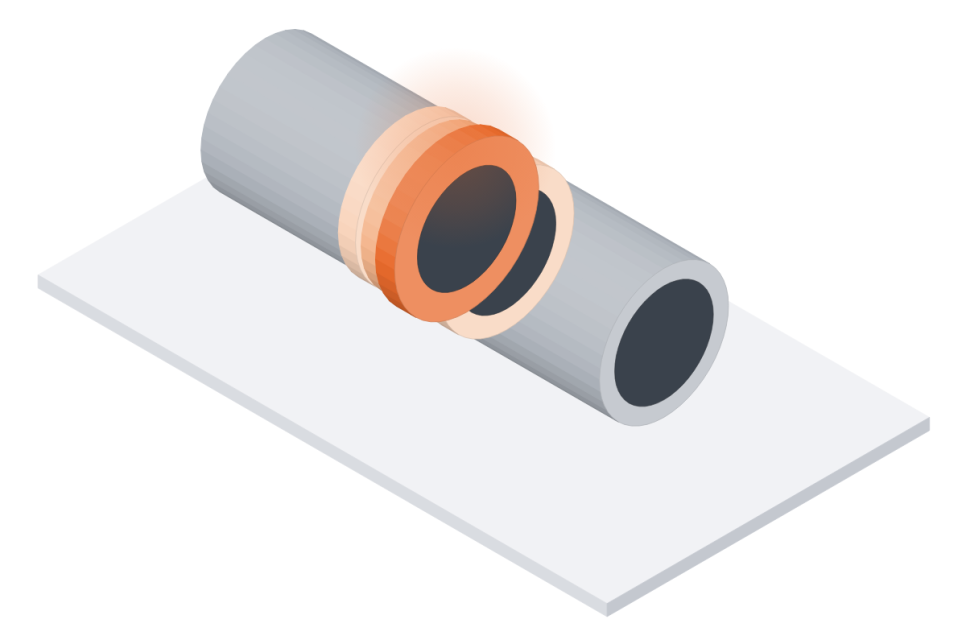
The weld joining two pipes (dark orange) and the bands on both sides that received heat (light orange)
High-purity gas piping and purified water and water-for-injection systems generally recommend 316L. General food and beverage and hygienic lines are often configured with 304 hygienic fittings, and pharmaceutical and biotech processes often specify 316L. What the drawing says comes first.
VALVEPARK compares the material designations on your drawing, listens to the medium and chloride conditions, and then suggests 304 and 316 family products.
| General food and beverage and hygienic piping, 304 drawing | Sanitary SUS304 fittings Clamps, ferrules, elbows, tees, concentric reducers |
| Hygienic line valve, 316 drawing | Sanitary 2WAY and 3WAY ball valves (SUS316) SS316 body, TFM-1600 seat |
| General industrial piping, 316 drawing | 3PC ball valve BSPT (SUS316) 1000 PSI, ISO 5211 pad |
| Vacuum piping, 316 drawing | Vacuum 2WAY ball valve (SUS316) KF NW16 to MF100 |
Clamps, ferrules, elbows, tees and concentric reducers are configured in SUS304. According to the product description, these fittings are used in pharmaceutical, biotech, chemical, food and beverage and secondary battery processes, and if the drawing specifies 316L, compare the material first.
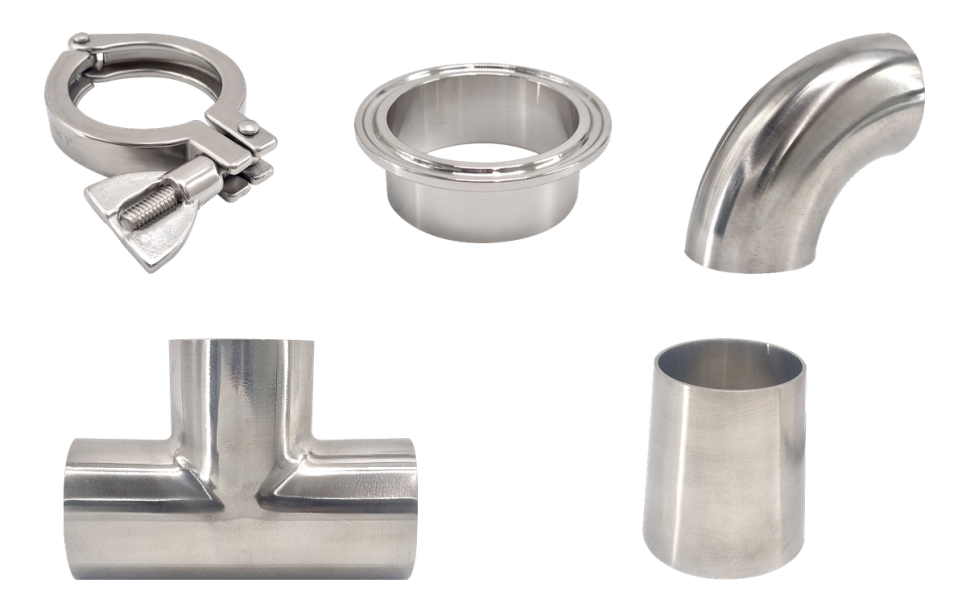
From the left: clamp, ferrule, 90-degree short elbow, equal tee and concentric reducer
Material: SUS304
Connection: 2-stage clamp, welding (ferrule, elbow, tee, concentric reducer)
Sanitary 2WAY and 3WAY ball valves (SUS316): hygienic line valves for 316 drawings
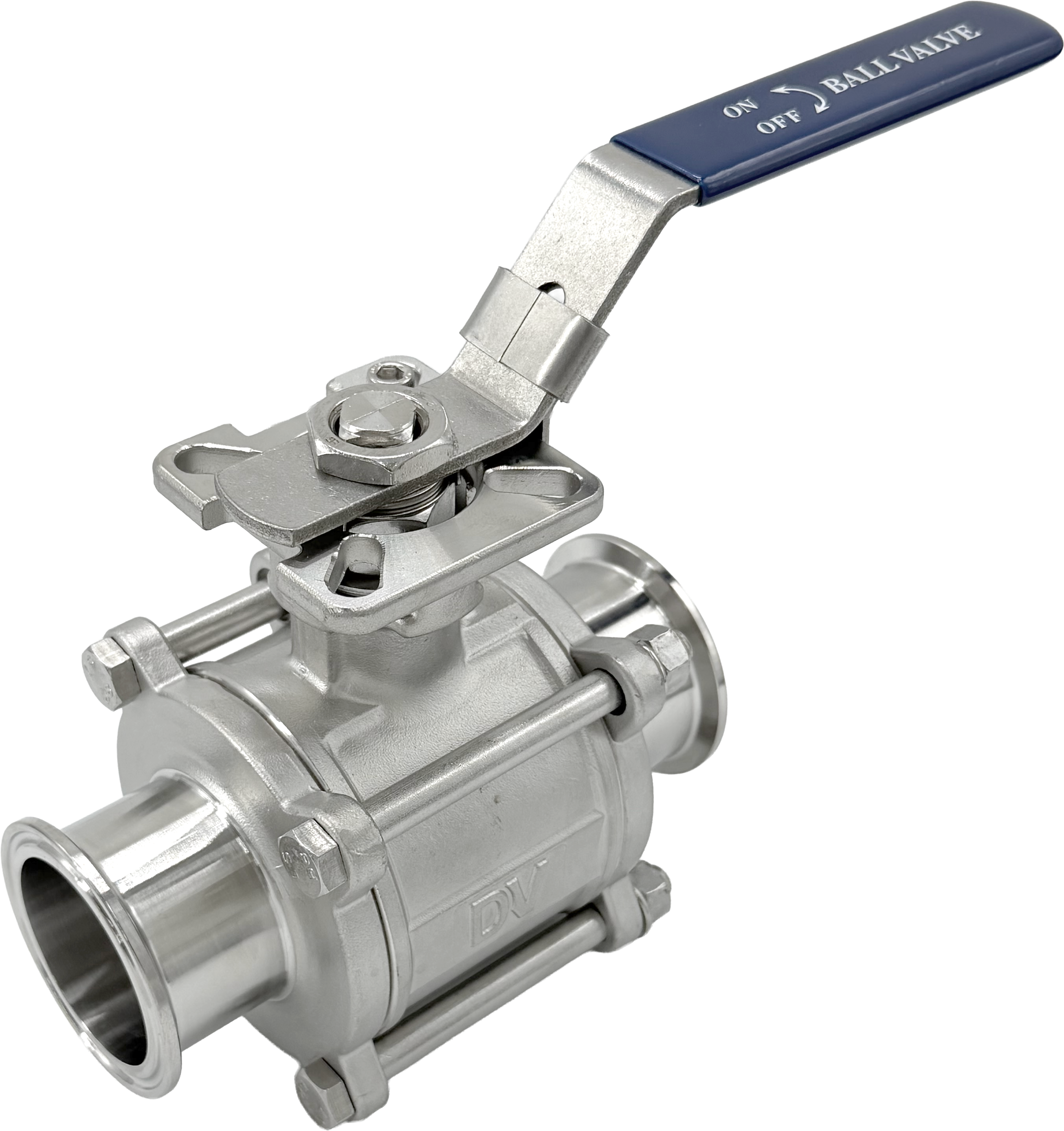
The 2WAY ball valve has a 3PC construction with an SS316 body, a TFM-1600 seat and an ISO 5211 direct-mount pad, in sizes from 0.5S to 4.0S. The 2WAY body is supplied in SS316 (CF8M) and SS316L (CF3M), and if the drawing says 316L, we compare it against these designations and suggest the material.
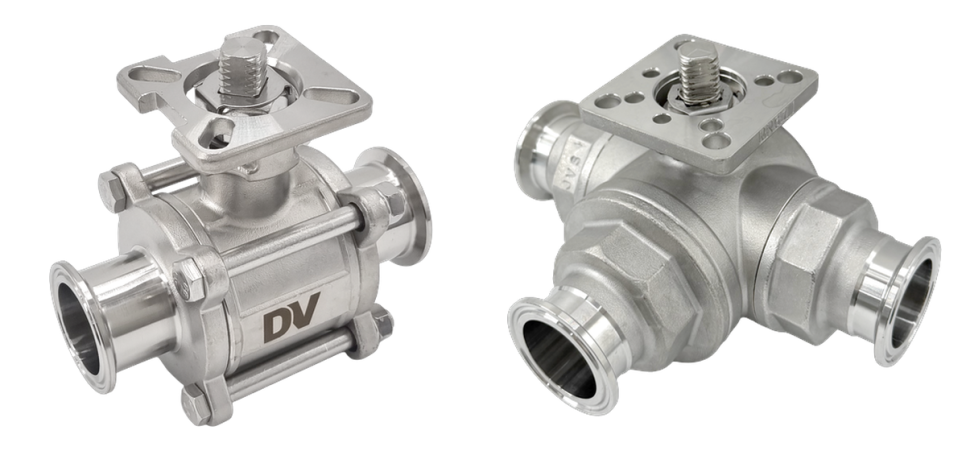
2WAY ball valve on the left, 3WAY ball valve on the right
2WAY: clamp connection, sizes 0.5S to 4.0S
3WAY: SS316 body, TFM-1600 seat, clamp connection, sizes 0.5S to 2.0S, L and T ports
3PC ball valve BSPT (SUS316): general industrial piping for 316 drawings
A 3PC construction with an SS316 precision-cast body and an SS316 ball with a PTFE seat. The operating pressure is 1000 PSI, it has an ISO 5211 pad, and the sizes run from 008A to 100A.
Vacuum 2WAY ball valve (SUS316): vacuum piping for 316 drawings
It uses an SS316 3PC body with a PTFE seat and connects from KF NW16 to MF100.
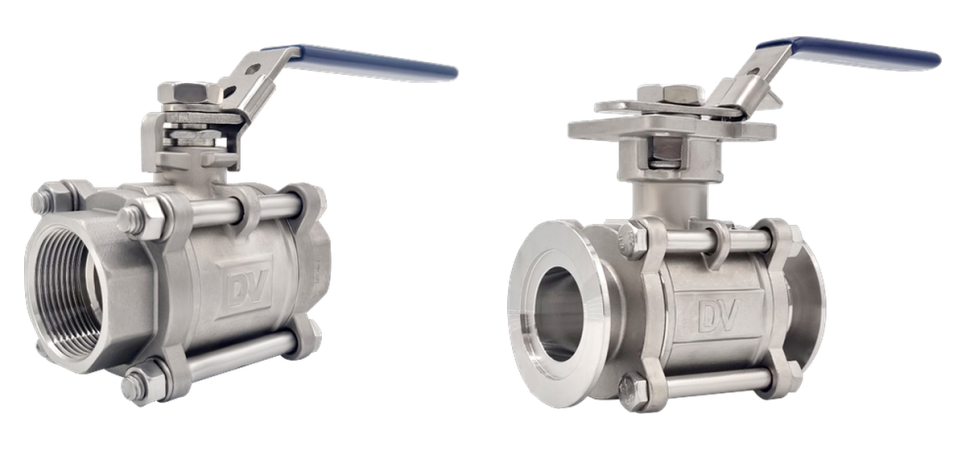
3PC ball valve BSPT on the left, vacuum 2WAY ball valve on the right
Q. Can I put in SUS316 for a 316L drawing?
We lean toward following the drawing's material as is. The carbon upper limit of 316 is around 0.08%, higher than the 0.03% of 316L, so for welded piping the reason the drawing specified L may be lost. A change of material needs confirmation from the side that made the drawing first.
Q. Are JIS SUS and KS STS the same material?
They point to the same 304 and 316 families, but the leading letters differ by standard. The KS designations for pipe and bar stock begin with STS, and for forgings the KS standard begins with STSF. On a purchase order, write the drawing designation as is and list JIS and KS together.
Q. I need a 316L specification; do you handle an item for it?
The Sanitary 2WAY ball valve (SV-01) is supplied with an SS316L (CF3M) body. For other items it differs by item, so we check by comparing the drawing designation with the item specification.
Q. Can I receive a material certificate?
Yes. Just state whether you need one when you request a quote.
Q. Is it impossible to manufacture in other materials such as Hastelloy or duplex?
It is possible. However, an MOQ (minimum order quantity) may apply depending on the request. VALVEPARK looks into every way to make it in the material you request. Please contact us for detailed conditions.
If you send the information below, we can start a review that compares your drawing designations and suggests a material.
1️⃣ Drawing material and standard designation: exactly as written on the drawing (example: A182 F316L, 1.4404, CF8M)
2️⃣ Medium: type, whether it contains chlorides (chloride ions), and whether cleaning or sterilizing solutions are used
3️⃣ Temperature: continuous and peak temperature
4️⃣ Whether welded and the connection type (clamp, weld, thread, flange)
5️⃣ Size and quantity, and the material designation used on the purchase order
6️⃣ Whether a material certificate is needed
Please contact us if you need a specification sheet or detailed materials.
▸ View product: Sanitary 2WAY ball valve SUS316 manual and bare
▸ See also: Sanitary SUS304 clamp
Purchase and Inquiries
| sales@valvepark.com | |
| Phone | 1666-0215 |
| KakaoTalk channel | KakaoTalk consultation |
| Website | Go to the VALVEPARK website |
| Smart Store | Go to the VALVEPARK Smart Store |