Vacuum 2WAY Ball Valve (SUS316, Manual/Automatic)
Model: PVV-01
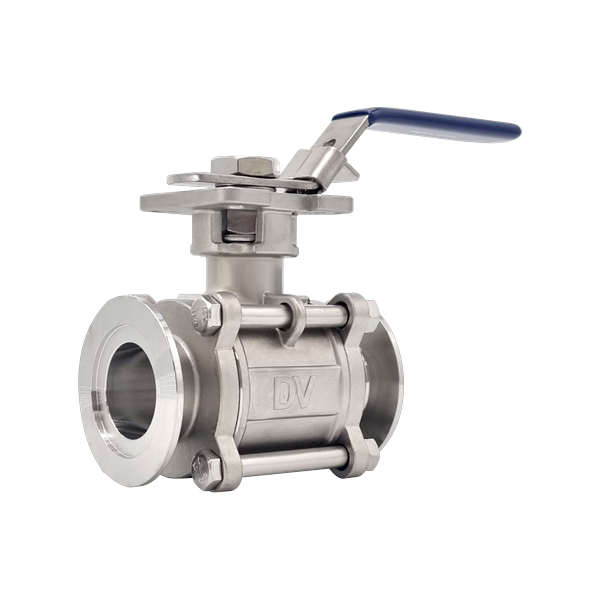
PVV-01 is a vacuum 2WAY ball valve featuring a SUS316 3PC body with a full-port design. Supplied as a dual-purpose specification (bare shaft) for both manual handle and automatic actuator use and supporting sizes from NW16 up to NW100 (ISO), it is used for shutoff of vacuum lines in semiconductor, display, solar, and laboratory processes.
Features
- Compact design for easy installation in confined spaces
- 3PC structure for easy installation and maintenance
- Internal oil removal (CLEAN AND OIL FREE)
- 100% helium leak tested
- Custom manufacturing available per customer needs
- Available in large sizes NW16-100 (ISO)
- First in Korea: ISO5211 Direct Mounting Pad (Part-Turn Actuator Attachments) - direct actuator coupling without separate bracket or parts
Specifications
| End Connection | KF |
| Material | SS316 |
| Ball/Disc Material | SS316 |
| Seat Material | PTFE |
| Operation | Lever, Bare |
| Origin | Taiwan |
| Size | NW16, NW25, NW40, NW50, MF63, MF80, MF100 |
Frequently Asked Questions
- How is the manual/automatic dual-use specification operated?
- The manual/automatic dual-use (bare shaft) specification is supplied with only the stem exposed, designed so that initial operation is performed manually with a manual handle attached, and later switched to automation by attaching a pneumatic or electric actuator. Since the ISO5211 direct mounting pad is used, only the upper drive section needs to be changed without body replacement.
- How do I choose between ball valves and bellows valves in vacuum lines?
- Ball valves are suitable for general gas and exhaust lines thanks to their full-port design with low flow loss and fast operation. Bellows valves have the stem seal isolated from the atmosphere by a metal bellows, advantageous in high-vacuum and corrosive gas environments, but with complex structure and high price. Choose ball valves for general HV lines, bellows valves for high-vacuum, long-life, and corrosive environments.
- What advantages does the 3PC structure provide in vacuum lines?
- The 3PC structure has a separable central body and end caps, allowing seat, ball, and seal maintenance without dismantling the piping. For vacuum lines with frequent regular inspections or suspected seat damage, rapid maintenance is possible, contributing to reduced line downtime.
- What level of vacuum can it be used to?
- PVV-01 is designed for shutoff in the high vacuum (HV) range. The actual achievable vacuum varies greatly with chamber volume, pumping system, operating temperature, and gas type, and separate specification review is required for environments requiring ultra-high vacuum (UHV).