
About this series · Semiconductor Vacuum System Component Guide (5 parts)
- Part 1 Overall layout and gas supply: UHP valves, MFCs, check valves ◀ You are reading this part
- Part 2 Chamber valves: gate valves and throttle valves
- Part 3 Pumps: dry pumps and turbomolecular pumps
- Part 4 Piping connections: KF, ISO, and CF flanges
- Part 5 Pressure measurement: vacuum gauges and a checklist before choosing parts
At a glance
- Layout: gas supply section, chamber, valves, pumps, gauges, and piping components
- Gas supply section: UHP valves for cleanliness, an MFC for flow rate, a check valve for backflow
- VALVEPARK: we listen to your gas type and flow rate, propose a matching combination, and supply it directly
A semiconductor vacuum system is made up of a gas supply section, a chamber, valves, pumps, gauges, and piping components. This series follows the gas from where it enters to the dry pump in five parts, covering which technology each section needs and which products are used there. Part 1 looks at the overall layout first, then at the gas supply section that the gas passes through first.

The pipe on the right side of the figure is the roughing line. Roughing is the stage that pumps a chamber (the sealed vessel where wafers are loaded and processed) down from atmospheric pressure to a rough vacuum. At this stage the dry pump pumps directly, without going through the turbomolecular pump. The pipe that connects the turbomolecular pump's exhaust port to the pump behind it is called the foreline.
A semiconductor chamber is demanding because three things have to be right at the same time.
So when choosing components, it is not enough to check that the specification fits. You also need to consider whether the component could cause contamination, leaks, or pressure instability at that location. For reference, the pressure unit in this series is mbar. 1 mbar is 100 Pa, and 1 Torr is about 133.32 Pa.
It is not enough to check that the specification fits. You also need to consider whether the component could cause contamination, leaks, or pressure instability at that location.
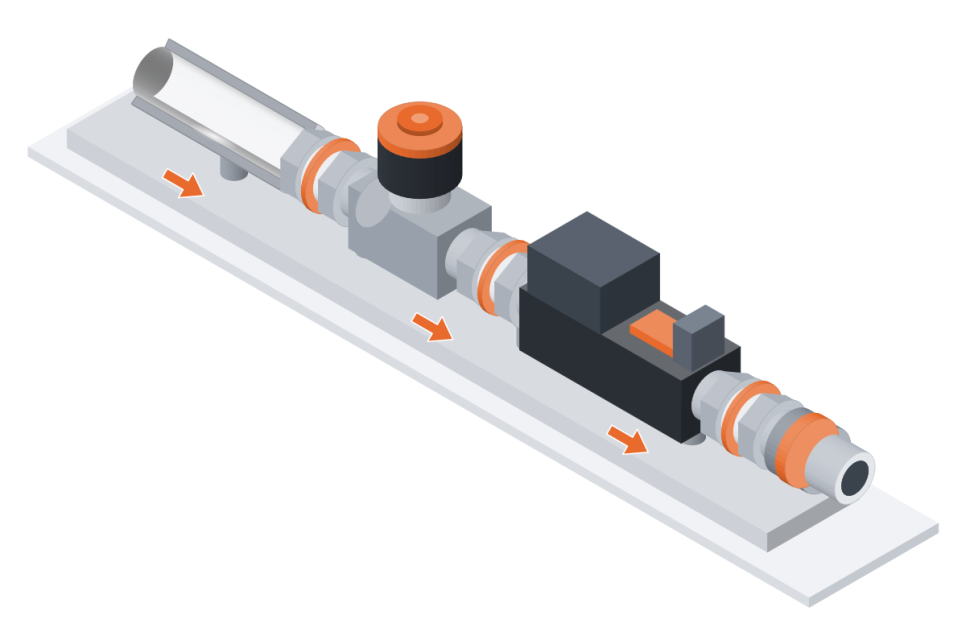
Because process gas has to enter the chamber without contamination and in a set amount. UHP valves take care of cleanliness, the MFC takes care of flow rate, and a check valve prevents backflow.
An MFC (mass flow controller) is a device that combines a flow meter, a control circuit, and a control valve in one body and passes gas at the set flow rate. Thermal MFCs come in models ranging from very small flows on the order of 0.01 sccm up to large flows on the order of 1000 SLPM, so you need to decide your gas and flow range first. sccm is the gas volume (in cm³) that flows per minute at standard conditions, and SLPM is the same standard in liters. Where you only need to measure flow, use an MFM (mass flow meter).
UHP valves take care of cleanliness, the MFC takes care of flow rate, and a check valve prevents backflow.
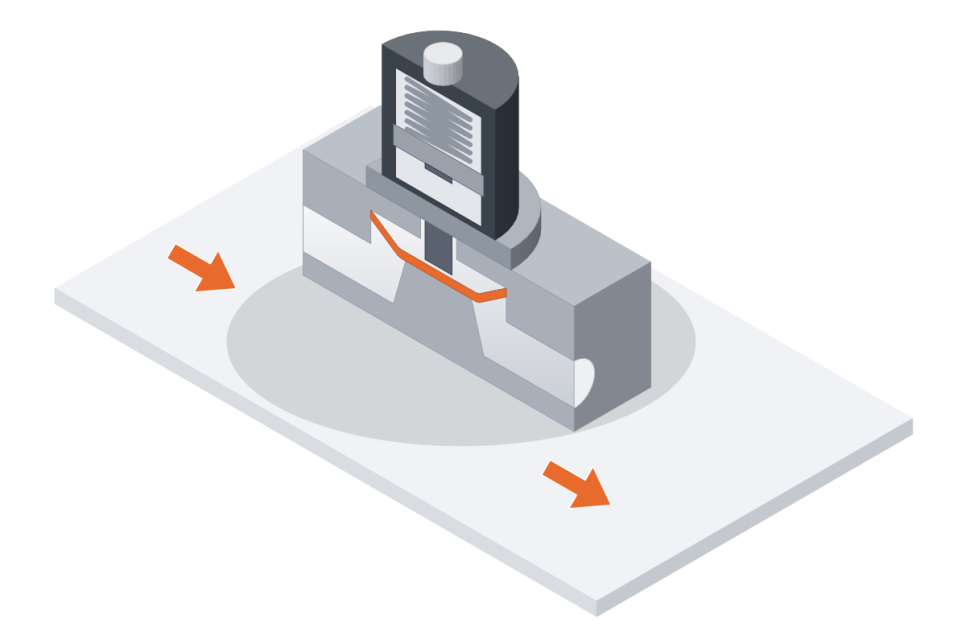
There is no sliding stem or packing in the space the gas passes through. A diaphragm valve opens and closes the flow path by pressing a thin metal membrane (the diaphragm) against the seat, so the moving parts and the gas passage are separated by that one membrane. As a result, particles generated by friction do not mix into the gas, and there are fewer corners where gas can stagnate.
On top of that, the gas-wetted inner surface is electropolished and passivated to reduce the places where particles can cling, and that is the UHP (ultra-high-purity) specification. Electropolishing is a finish that smooths a metal surface by dissolving it slightly through an electrochemical process. One manufacturer's data sheet controls the roughness of the gas-wetted surface at about Ra 5 µin (about 0.13 µm), and lists Ra 8 µin for some diaphragm valves. Even among UHP products the value differs by manufacturer and series, so be sure to check the surface roughness in the catalog.
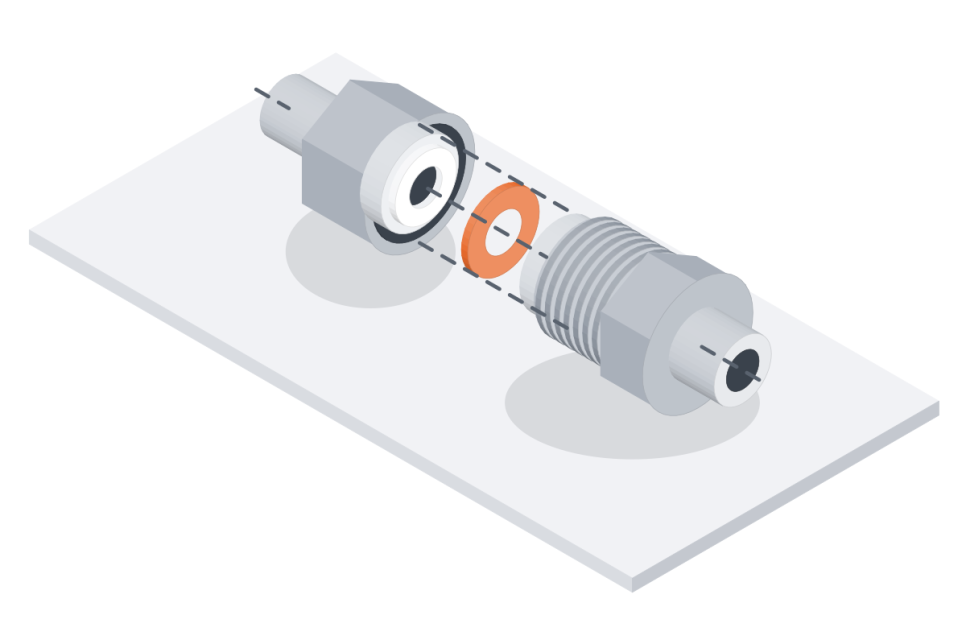
VCR fittings connect high-purity gas lines without leaks, and check valves stop gas from flowing backward.
A VCR fitting is a connection that seals by placing a metal gasket between two bodies and tightening a nut. Because it seals metal against metal instead of using a rubber O-ring, it is widely used on high-purity gas lines. The gasket is deformed as it is tightened, so the rule is to replace it with a new gasket whenever you loosen the fitting and tighten it again.
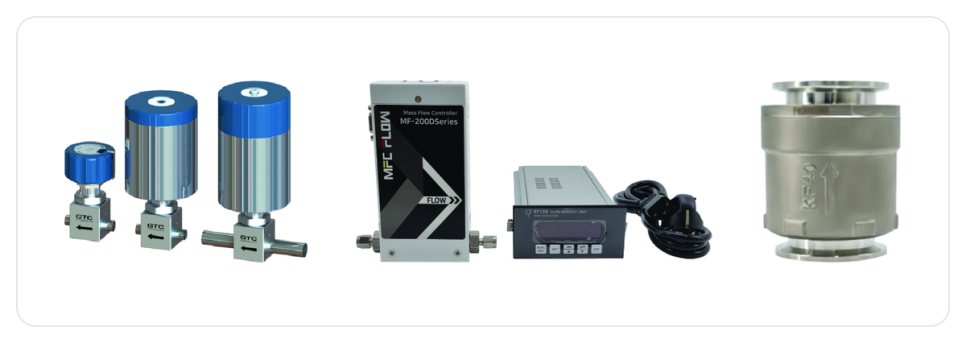
The VALVEPARK Vacuum Check Valve Any Direction can be installed in any direction, vertical or horizontal, as its name says. Per the product page, its leak rate is 1×10⁻⁸ mbar·L/s and its minimum opening differential pressure is about 7 mbar. The leak rate is the amount of gas that leaks through while the valve is closed. On the other hand, for ordinary compressed-air or water piping the UHP specification may be excessive, so it is best to confirm the application first.
| VALVEPARK recommended configuration | ||
|---|---|---|
| Shut-off | GTC DV2 UHP diaphragm valve | UHP specification with an electropolished and passivated inner surface |
| Flow control | MFC FLOW MF-300DC mass flow controller | Flow meter, control circuit, and control valve in one body |
| Backflow prevention | VALVEPARK Vacuum Check Valve Any Direction | Vertical or horizontal installation, leak rate 1×10⁻⁸ mbar·L/s |
▸ Tell us your gas type and surface roughness grade, and a VALVEPARK engineer will select a matching combination of UHP valves and fittings.
Q. What surface roughness should I look for on a UHP valve?
A. According to one manufacturer's data sheet, the gas-wetted surface is about Ra 5 µin (about 0.13 µm), and some diaphragm valves are Ra 8 µin. It differs by manufacturer and series, so check the catalog value.
Q. How are an MFC and an MFM different?
A. An MFC measures the flow and also adjusts it to the set value, while an MFM only measures. Use an MFC on process lines where the flow has to change, and an MFM where you only need to confirm the flow.
Q. Do I need UHP valves on ordinary compressed-air piping too?
A. No. The UHP specification is for lines that must avoid contamination at all costs, such as semiconductor process gas. For ordinary compressed-air or water piping, a standard valve suited to the application is the better choice.
Q. Can a VCR gasket be reused?
A. We do not recommend it. A gasket is deformed once it has been tightened, so replace it with a new one whenever you tighten the fitting again.
▸ Next: Part 2 Chamber valves, gate valves and throttle valves
📞 Purchase and inquiries
📩 VALVEPARK official contact
Email: sales@valvepark.com
Phone: 1666-0215
KakaoTalk channel: https://pf.kakao.com/_lxftVxj
Buying piping materials becomes the easiest, fastest task.
📦 You can find product details and purchase information at the links below.
Homepage: https://www.valvepark.com/?utm_source=naver_blog&utm_medium=blog&utm_campaign=semiconductor-vacuum-1-gas-supply
Smartstore: https://smartstore.naver.com/valvepark?nt_source=naver_blog&nt_medium=blog&nt_detail=semiconductor-vacuum-1-gas-supply