Cleanroom Wiper (Non-Woven, Spunlace, 1 Pack)
This cleanroom wiper is a high-performance product that combines polyester and pulp using the spunlace process to minimize fiber shedding and dust scattering. With excellent chemical resistance and absorbency, it effectively removes contamination from facilities and equipment in industrial sites requiring a high level of cleanliness, such as semiconductor, display, and solar applications. It can be applied across a wide range from semi-cleanroom to cleanroom environments, and provides the best cleanliness-maintenance solution with quality already proven in the cleanrooms of major corporations.
Features
- Spunlace process minimizes fiber shedding and dust dispersion
- Significantly reduced particle and lint generation compared to bonded/heat-sealed methods
- Excellent chemical resistance - usable in various chemical environments
- Excellent absorbency and high absorption capacity - effective for removing liquid contaminants
- Different surface patterns on each side for excellent contaminant capture and cleaning efficiency
- Suitable for semi-cleanroom and cleanroom environments
- Usable in wet/dry mode on equipment, machinery, and floors
- Verified for use in major corporate cleanroom environments
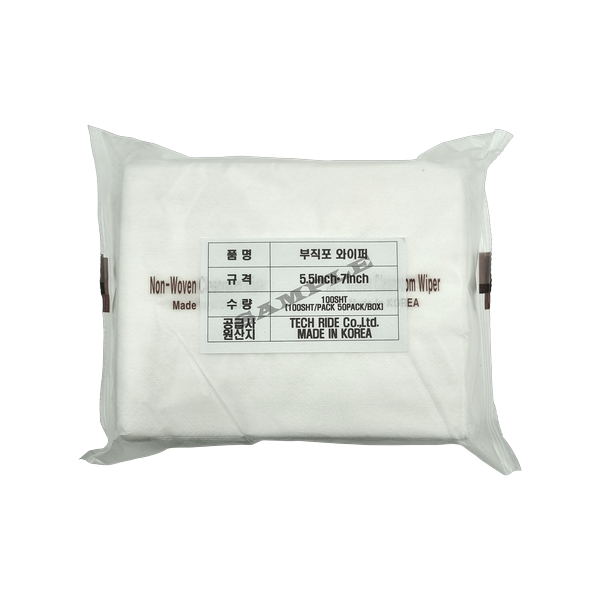
Specifications
| Material | Polyester + Pulp |
| Manufacturing Process | Spunlace (hydroentangled) |
| Size | 9" × 9" (230 × 230mm) |
| Quantity | 100 sheets / pack |
| Box Configuration | 50 packs / box |
| Usage Method | Wet / dry combined use |
| Application Environment | Semi-cleanroom to cleanroom |
Frequently Asked Questions
- What advantages does the Spunlace process of cleanroom wipers offer compared with traditional bonded or thermally bonded methods?
- Because the Spunlace process forms the fabric through physical entanglement of fibers, it significantly reduces particle and lint generation caused by adhesives or heat used in bonded or thermally bonded methods. This is a key difference that minimizes contamination risk in cleanroom environments.
- How reliable is the chemical resistance of this cleanroom wiper?
- This wiper has been validated in cleanroom environments at major corporations and offers excellent chemical resistance to a wide range of cleaning solutions and solvents. For resistance against specific chemicals, please contact our technical support team for detailed data.
- How does the difference between the two surface patterns improve efficiency in actual cleaning work?
- Cleanroom wipers are designed with different surface patterns on each side. One side is optimized for fine foreign-matter absorption, while the other side is designed to effectively remove contaminants over a wider area, allowing operators to choose the side based on contamination type to maximize cleaning efficiency.