About this series · Semiconductor Vacuum System Component Guide (5 parts)
- Part 1 Overall layout and gas supply: UHP valves, MFCs, check valves
- Part 2 Chamber valves: gate valves and throttle valves
- Part 3 Pumps: dry pumps and turbomolecular pumps ◀ You are reading this part
- Part 4 Piping connections: KF, ISO, and CF flanges
- Part 5 Pressure measurement: vacuum gauges and a checklist before choosing parts
Previously
Part 2 covered the valves between the chamber and the pump. A gate valve shuts off the line, a throttle valve sets chamber pressure by how far it is open, and bellows-sealed angle valves are widely used on the roughing line.
At a glance
- Dry pump: an oil-free pump that handles roughing and backing
- Turbomolecular pump: creates high vacuum but cannot pump down to atmospheric pressure on its own
- VALVEPARK: tell us your process gas and pumping capacity, and we will match the pump combination, including backing matching
The pumps on a semiconductor vacuum line usually work in two stages. A turbomolecular pump right behind the chamber creates high vacuum, and a dry pump behind it supports it and also handles roughing. Part 3 covers why dry pumps are used instead of oil pumps and how a turbomolecular pump is connected.
Because oil contamination has to be prevented, and the pump has to withstand corrosive gases and particles.
To get a clean, hydrocarbon-free vacuum, you need to back an oil-free turbomolecular pump with a dry pump.
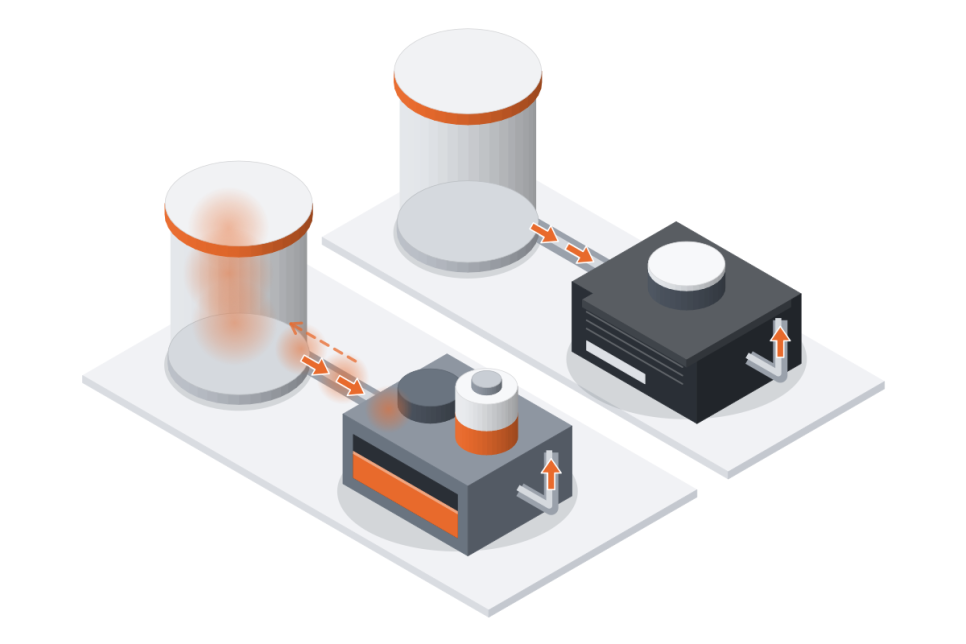
Here are the two pumps side by side.
| Comparison | Oil rotary pump | Dry pump |
|---|---|---|
| Sealing method | Sealed and lubricated with oil | No liquid seal |
| Contamination on the chamber side | Oil vapor can rise when chamber pressure is below about 15 Pa (0.15 mbar) | No oil vapor backstreaming |
| Particles and corrosive gases | Oil condition must be checked and the oil changed | Purge gas keeps particles from building up |
| Backing for a turbomolecular pump | Not suitable when a clean vacuum is needed | Used in clean vacuum configurations |
| Suited to | General roughing and auxiliary pumping where oil contamination is not a major concern | Semiconductor chamber pumping, backing for turbomolecular pumps |
In summary, because an oil rotary pump seals with oil, oil vapor can rise into the chamber below about 15 Pa, so it suits places where oil contamination is not a major concern. A dry pump has no liquid seal, so it is used for semiconductor chamber pumping and for backing a turbomolecular pump. This is only a general distinction, though, and in practice you decide based on the process gas and the required cleanliness.
A turbomolecular pump (TMP) creates high vacuum by knocking gas molecules away with rapidly spinning blades. Rotating blades and fixed blades are stacked in alternating layers, pushing the molecules down one layer at a time.
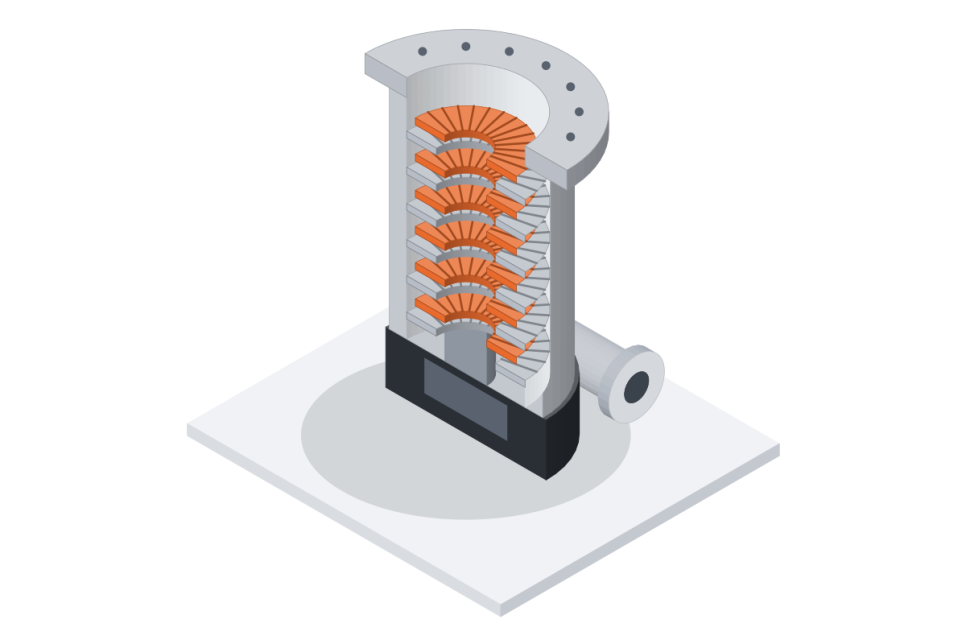
It cannot pump down to atmospheric pressure on its own, so a backing pump must always be connected behind it, and on semiconductor lines a dry pump takes that place. A backing pump is an auxiliary pump that keeps the pressure at the turbomolecular pump's exhaust port low. The piping that connects the turbomolecular pump's exhaust port to the dry pump is called the foreline.
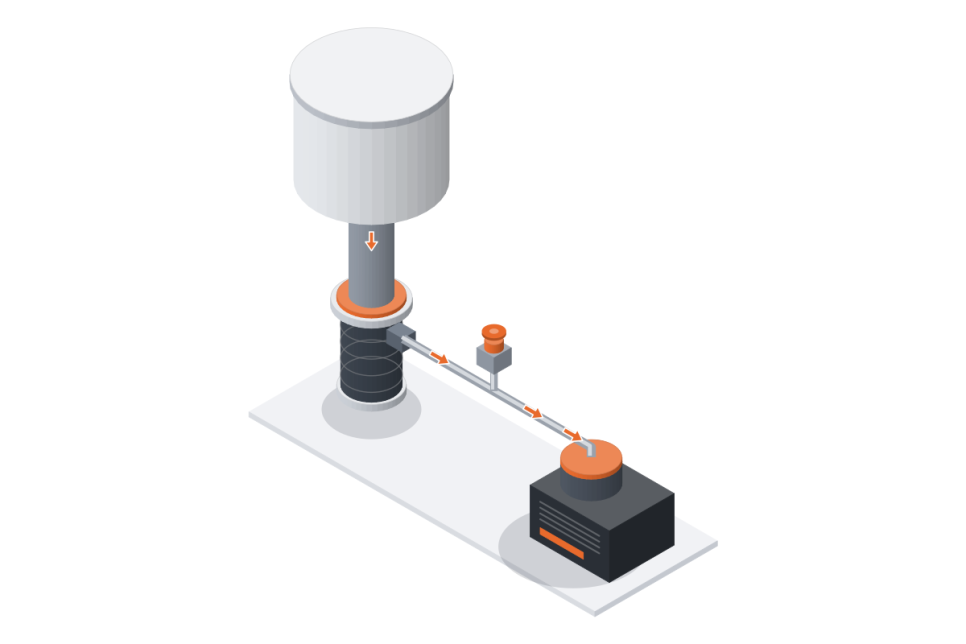
A turbomolecular pump itself does not send hydrocarbons back up, but after a stop or a power outage, if you do not vent, oil vapor in the foreline can spread into the chamber. Do not forget to keep foreign objects from entering the inlet either.
| VALVEPARK recommended configuration | ||
|---|---|---|
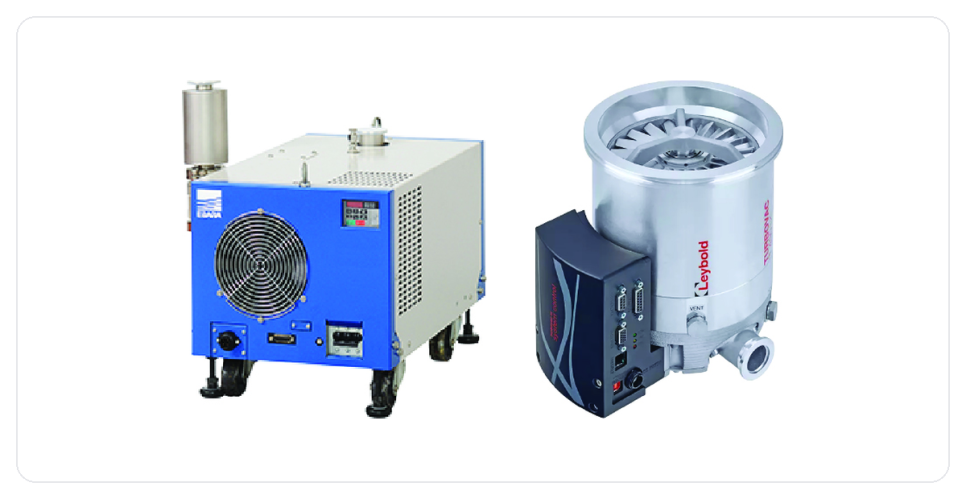
| Roughing and backing | EBARA EV-X dry vacuum pump | Dry type with no liquid seal |
| High vacuum | EBARA EMT magnetic bearing turbomolecular pump | Magnetic bearing type |
| High vacuum | LEYBOLD TURBOVAC 450iiX turbomolecular pump | DN160 ISO-K connection |
▸ Tell us your process gas and the pumping capacity you need, and we will match the dry pump and turbomolecular pump combination, including backing matching.
Q. Is a turbomolecular pump alone enough to create a vacuum?
A. No. A turbomolecular pump cannot pump down to atmospheric pressure on its own, so it needs a backing pump behind it. On semiconductor lines a dry pump is usually connected.
Q. Why is purge gas injected into a dry pump?
A. To keep particles and byproducts from the process from building up inside the pump. If they build up, pump performance drops and failures become more frequent.
Q. What should I do if a turbomolecular pump stops because of a power outage?
A. Follow the venting procedure. If you leave it without venting, oil vapor in the foreline can spread into the chamber.
◂ Previous: Part 2 Chamber valves, gate valves and throttle valves
▸ Next: Part 4 Piping connections, KF, ISO, and CF flanges
📞 Purchase and inquiries
📩 VALVEPARK official contact
Email: sales@valvepark.com
Phone: 1666-0215
KakaoTalk channel: https://pf.kakao.com/_lxftVxj
Buying piping materials becomes the easiest, fastest task.
📦 You can find product details and purchase information at the links below.
Homepage: https://www.valvepark.com/?utm_source=naver_blog&utm_medium=blog&utm_campaign=semiconductor-vacuum-3-pumps
Smartstore: https://smartstore.naver.com/valvepark?nt_source=naver_blog&nt_medium=blog&nt_detail=semiconductor-vacuum-3-pumps