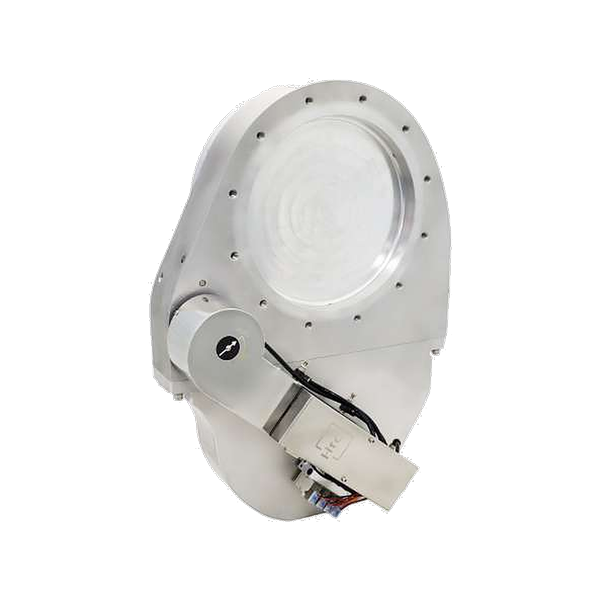
HTC 3-Position Pendulum Valve

The HTC 3-position pendulum valve is an electro-pneumatically actuated vacuum valve installed between the process chamber and the turbomolecular pump. In addition to open and closed, it has one intermediate position for a single step of pressure adjustment, and reed sensors confirm the position. It connects with ISO200, ISO250 and ISO320 flanges.
Features

HTC 3-Position Pendulum ValveHTC 3-Position Pendulum Valve 2

Specifications

Body MaterialA6061-T6
Gate MaterialA6061-T6
ConnectionISO200/ISO250/ISO320 flange
ActuatorElectro-Pneumatic
PositionsOpen, closed, intermediate
Position FeedbackReed sensors
Solenoid VoltageDC24V
Compressed Air Pressure4 to 6 kg/cm²
Helium Leak Rate (1 atm differential)Aluminum body < 1×10⁻⁹ mbar·L/s; hard-anodized body < 1×10⁻⁵ mbar·L/s
Pressure RangeAluminum body 1×10⁻⁸ mbar to 1.2 bar; hard-anodized body 1×10⁻⁶ mbar to 1.2 bar
Maximum Differential Pressure1.2 bar (5 mbar or less during opening)
Bake TemperatureBody ≤120℃, actuator ≤80℃, solenoid valve ≤50℃
Life Cycle200,000 open/close cycles
SealViton O-ring (gate/bonnet)
WeightISO200 22 kg, ISO250 32 kg, ISO320 52 kg
Mounting PositionHorizontal, vertical
OptionsOther gate O-ring material; heater

Frequently Asked Questions

How is it different from the APC type?
The 3-position type uses an electro-pneumatic cylinder to move between open, closed and one intermediate position, adjusting pressure in a single step. Continuous pressure control by varying the opening is handled by the APC type, which uses a step motor and a dedicated controller.
How do the aluminum body and the hard-anodized body differ in specification?
The aluminum body has a helium leak rate below 1×10⁻⁹ mbar·L/s and a pressure range of 1×10⁻⁸ mbar to 1.2 bar. The hard-anodized body has a helium leak rate below 1×10⁻⁵ mbar·L/s and a pressure range of 1×10⁻⁶ mbar to 1.2 bar. Both leak rates are the manufacturer's catalog values at 1 atm differential.
How are external control signals connected?
A DA-15 connector takes the 24 VDC supply and the open, close and intermediate-position input signals, and returns the open, close and intermediate-position (3A, 3B) output signals. 24AWG wire is recommended.
How can I check whether it fits existing equipment?
Port diameter, flange O.D. and bolt P.C.D. can be compared against the dimension table first. Valve length and actuator position are checked against the drawing. Even at the same nominal size, fit cannot be confirmed before the drawing is reviewed.