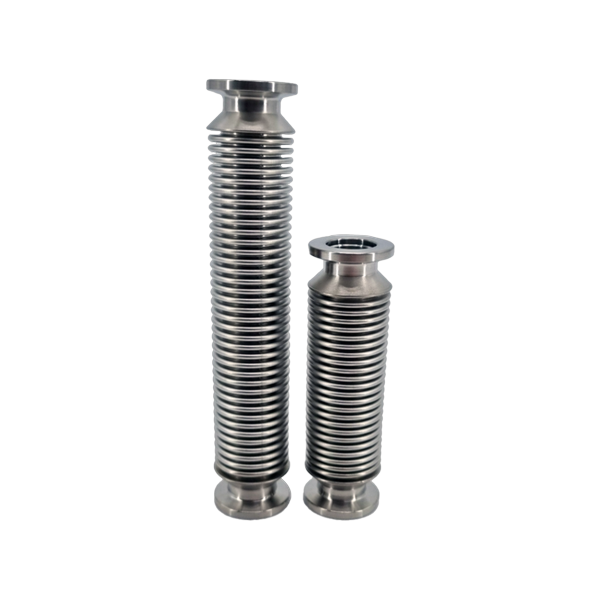
Vacuum Formed Bellows
Model: PVF-11
PVF-11 is a formed-type bellows used at vacuum-piping joints. By absorbing thermal expansion, alignment errors, and vibration to maintain the airtightness and stability of vacuum lines, it is used at piping connections in semiconductor, display, solar manufacturing processes, and laboratory vacuum equipment.
Specifications
| Material | SS304 |
| Origin | South Korea |
Frequently Asked Questions
- How do formed bellows and welded bellows differ?
- Formed bellows are made by pressing thin stainless tubes with a die to form corrugations - simple in structure and lower in cost, widely used in general high vacuum (HV) piping. Welded bellows are made by individually welding multiple discs, with greater displacement per unit length and applicability up to UHV ranges, but at higher cost. For general HV vacuum-line conditions, formed bellows are sufficient in most cases.
- How is bellows lifetime determined?
- Bellows lifetime is mainly determined by the combination of displacement per cycle and the number of cycles. Exceeding the allowed displacement or operating beyond the design cycle count may cause fatigue cracks at the corrugation roots. Tell us the displacement size and expected cycles in the installation environment and we will review appropriate specifications together.
- Are there any precautions during installation?
- Bellows lifetime is significantly shortened by excessive eccentricity or torsional stress. As a rule, align the coaxiality of both end flanges and constrain non-axial displacement with guides or brackets. Also, when welding nearby, protect the corrugations so spatter does not contact them.
- Up to what vacuum level can it be used?
- PVF-11 is suitable for use in the general high vacuum (HV) range. For environments requiring ultra-high vacuum (UHV) or lines requiring bake-out, welded bellows or separate specification review is needed, so tell us the operating environment and we will advise on suitability.