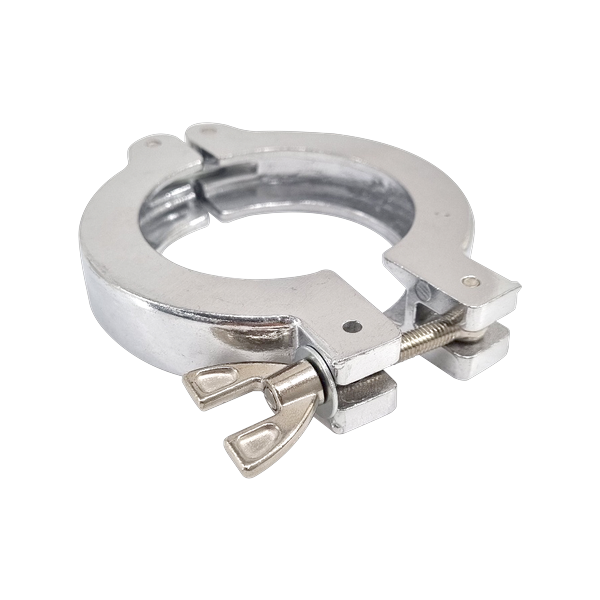
Vacuum KF Hinged Clamp (Double Pin)
Model: PVF-01(DA)
PVF-01(DA) is a hinged-type aluminum clamp that secures KF (NW) flanges, featuring a double-pin two-stage hinge structure. Wing-nut operation enables tool-free installation and removal, and it is used for removable flange connections on vacuum piping in semiconductor, display, solar, and laboratory applications.
Specifications
| Material | AL |
| Origin | China |
| Size | NW16, NW25, NW40, NW50 |
Frequently Asked Questions
- How do hinged-type and split-type clamps differ?
- A split clamp completely separates into two semicircles - simple in structure, but the two pieces must be handled separately during attachment/detachment. A hinged type has a hinge on one or both sides, embracing the flange without separating, which reduces the risk of the clamp falling away from the site or being assembled incorrectly during attachment/detachment. Hinged types are preferred at maintenance points with frequent disassembly and reassembly.
- What advantages does the double-pin two-stage hinge structure provide?
- A single-hinge clamp can have relatively weaker face pressure on the side opposite the hinge, while the double-pin two-stage hinge distributes the hinge across two locations to make the circumferential stress distribution uniform. This contributes to reducing the risk of micro-leakage due to tilting in lines with vibration or long-term fixed use.
- How do I choose between aluminum and stainless?
- Aluminum clamps offer advantages in light weight and price, and are widely used in general high vacuum (HV) lines. Stainless clamps offer excellent strength and corrosion resistance, suitable for environments with severe vibration, corrosive atmospheres, or high-temperature lines. Aluminum is the standard choice for typical vacuum exhaust lines.
- Must the centering ring always be used together?
- Yes. The KF flange system has a structure where the centering ring (with O-ring) is sandwiched between flanges and the clamp is fastened. Without the centering ring, the O-ring is not properly positioned and no seal is formed, so as a rule clamp, centering ring, and O-ring should be managed together as same-size sets.