Vacuum KF Flange (SUS304, SHORT-WELD)

Model: PVF-02

PVF-02 is a SHORT-WELD type flange used for KF (NW) standard vacuum-piping connections. With a SUS304 material and short weld-neck construction, it is used for weld connections at vacuum-piping ends and direct chamber interfaces in semiconductor, display, solar, and laboratory applications.
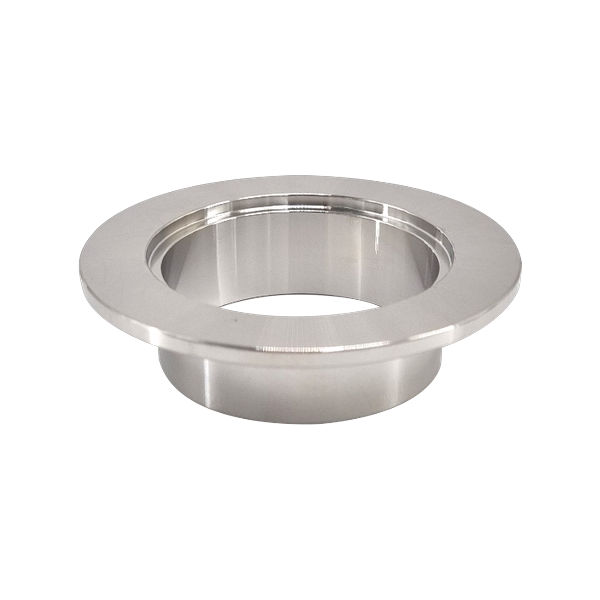
Vacuum KF Flange (SUS304, SHORT-WELD) PVF-02

Specifications

MaterialSS304
OriginChina, South Korea
SizeNW16, NW25, NW40, NW50, NW63, NW80, NW100, NW125, NW160, NW200

Frequently Asked Questions

How do I distinguish between SHORT-WELD and LONG-WELD types?
SHORT-WELD has a short weld neck length, suitable for sections with space constraints or for direct mounting to chamber walls. LONG-WELD has a longer weld neck, moving the heat-affected zone (HAZ) farther from the flange seal face, advantageous for lines where repeated thermal deformation is a concern or for high-precision flanges where post-weld deformation must be minimized. Choose LONG-WELD when installation space is ample and thermal deformation must be reduced; choose SHORT-WELD when space is limited.
How do I distinguish between welded and bolted connections?
Welded connections integrate the body with the flange, providing excellent long-term sealing and no leak path, but require piping disassembly for replacement. Bolted connections (direct flange fastening) are easy to attach/detach with good maintainability, but the bolted joint becomes a leak-management point. Welded type is general for fixed installations, while bolted or clamp type is selected for lines requiring repeated maintenance.
Up to what vacuum level can it be used?
The KF flange system is generally used widely from medium vacuum to high vacuum (HV). For environments requiring ultra-high vacuum (UHV), the CF flange system is appropriate, so tell us the operating environment and we will advise on suitability and alternatives.
Are there any precautions during welding?
For vacuum-line welding, the standard is to apply TIG welding in an argon back-purge environment so that no oxidation scale remains on the inner surface. Immediately after welding, internal cleaning is performed before introduction to the piping. For high-vacuum lines in particular, applying passivation as needed is advantageous for ensuring sealing performance.