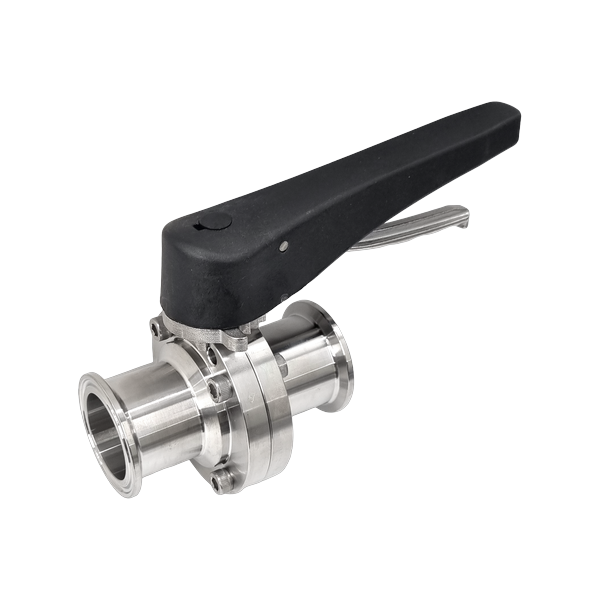
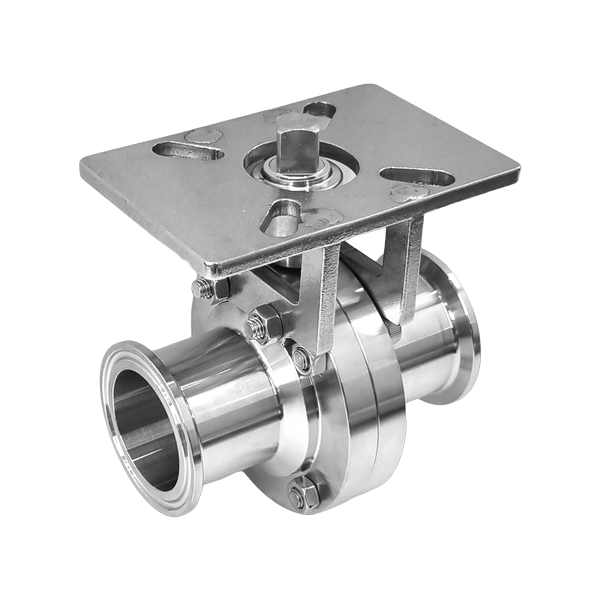
Sanitary Butterfly Valve (SUS316, Manual/Bare)
Model: PSV-04
PSV-04 is a sanitary butterfly valve featuring a SUS316 body and silicone seat. Manufactured following 3A sanitary standard design principles, with CLEAN AND OIL FREE treatment and an ISO5211 direct mounting pad applied as standard, it is used for sanitary shutoff and branching in pharmaceutical, biotechnology, chemical, food and beverage, and secondary battery processes.
Features
- High-quality Taiwanese-made stainless steel 316
- 3A international standard certified
- Internal oil removal (CLEAN AND OIL FREE)
- First in Korea to apply ISO5211 Direct Mounting Pad
Frequently Asked Questions
- What is the standard seat material of PSV-04?
- The standard seat material of PSV-04 is silicone. Silicone seats are adopted for their wide-temperature recovery elasticity, durability against repeated CIP/SIP, and compatibility with food and sanitary lines. If your process requires consideration of other seat materials (such as specific organic solvents or strong alkaline environments), share the operating conditions and we will review suitability together.
- What does 3A certification mean and how is it applied to this product?
- 3A is a sanitary standard for food and dairy processing equipment, evaluating surface finish, dead-space minimization, and cleanability. PSV-04 is manufactured referring to the design principles required by this standard. If your project requires issuance of an official certificate, please notify us in advance and we will advise on availability.
- How do disc opening and flow rate relate?
- Butterfly valves have a non-linear relationship between disc rotation angle and flow rate, with the practical flow-control range being approximately 30 to 70 degrees. Above 70 degrees, flow change relative to opening change is small, so they are not suited for precise flow control. For sections requiring precise control, use a globe control valve, and use PSV-04 for ON/OFF or simple branching.
- Are there any precautions during CIP/SIP operation?
- In lines with frequent SIP cycles, the seat compression state is a key factor for sustained performance. Applying an operating procedure that rotates the disc once or twice immediately after SIP to aid seat recovery helps reduce leakage risk. During regular inspection, check the condition of the seat surface and disc joint together.