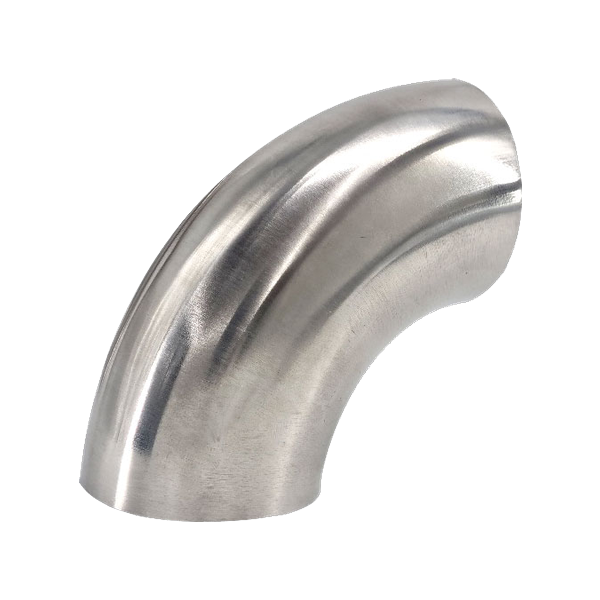
Sanitary 90° Short Elbow (SUS304, Weld)
Model: PSF-12
PSF-12 is a weld-type short elbow used for 90° direction changes in sanitary lines. With a precision-cast SUS304 body and standard sanitary-piping internal finishing, it is used for direction-change points in fixed piping for pharmaceutical, biotechnology, chemical, food and beverage, and secondary battery processes.
Specifications
| Material | SUS304 |
| Connection Type | For welding |
Frequently Asked Questions
- How do I choose between short-type and long-type elbows?
- The short type has a smaller curvature radius, saving installation space, but the sharper curvature creates relatively higher flow resistance and a tendency for partial turbulence during CIP cleaning. The long type has a larger curvature radius for smoother flow and better cleaning efficiency but takes up more piping space. Choose short type when space is the priority and long type when cleaning efficiency is the priority.
- How do I choose between weld-type and ferrule-type elbows?
- The weld type is used on main piping where the entire line is constructed as a continuously welded structure, offering excellent long-term hermeticity and minimized dead space. The ferrule type (single- or double-ferrule) allows tri-clamp disconnection and is suited to sections with frequent disassembly and reassembly. Use weld type for fixed main lines and ferrule type at disconnection points.
- Is there anything to watch out for during welding?
- On hygienic lines, the standard practice is to apply orbital welding under an argon back-purge environment to prevent oxide scale on the inner surface. Immediately after welding, internal cleaning and (where required) passivation are needed to meet the cleanliness requirements of hygienic lines.
- Which is appropriate, SUS304 or SUS316L?
- SUS304 is the standard for most general food, beverage, and hygienic lines. SUS316L is generally selected for lines with high chloride concentrations, lines containing strong organic acids, and GMP-grade pharmaceutical and biotech processes.